There’s a persistent myth about writers that refuses to die.
The idea is that stories simply arrive, fully formed, and all we have to do is type them out before they evaporate.
I wish.
Most stories begin as the tiniest spark. Sometimes it’s a character’s name. Sometimes it’s a setting. Sometimes it’s a theme, or a single line of dialogue. Sometimes it’s no more than a vague notion such as, “I’d like to write something set in Newfoundland.”
Occasionally there isn’t even that much. An editor says, “I need a fantasy story of about 8,000 words by next Thursday.”
Then the real work begins.
Writing fiction is, in many ways, a long series of decisions. Who is the main character? What do they want? What’s stopping them? Where does the story take place? Why does any of this matter? Every answer creates three more questions, until eventually the story takes shape.
Most novels and stories are built that way—one decision at a time. But every now and then…
Every now and then a story arrives almost complete. Rainmaker was one of those rare stories.
I found a note in one of my old notebooks about modern-day rainmakers. Yes, they’re still out there, offering to make it rain for drought-stricken communities. The instant I read that note, the entire story unfolded in my head. Not just the premise. The characters. The conflict. The ending. It all arrived together, as though my subconscious had quietly been working on it for weeks without telling me.
I wrote the story in one sitting. It was a very long day, but when I finally came up for air it was finished. There was remarkably little rewriting afterward, which is unusual for me.
From the very beginning, I knew I wasn’t going to submit Rainmaker anywhere. It felt like a gift for readers rather than a commercial release, so I reserved it as a free story for everyone who joins my readers’ list.
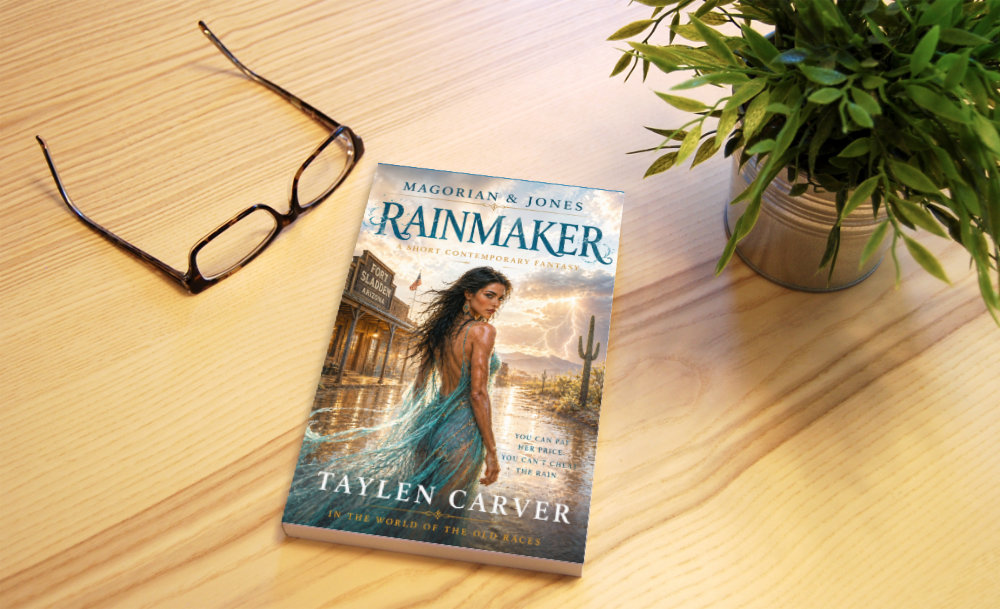
That did present one small problem. Stories need covers. Since Rainmaker was never going to earn any money, commissioning professional artwork wasn’t really an option. So I made the cover myself. It was perfectly serviceable. It looked like a book cover, it represented the story, and it did its job for several years.
Recently, though, I looked at it and thought… It deserves better.
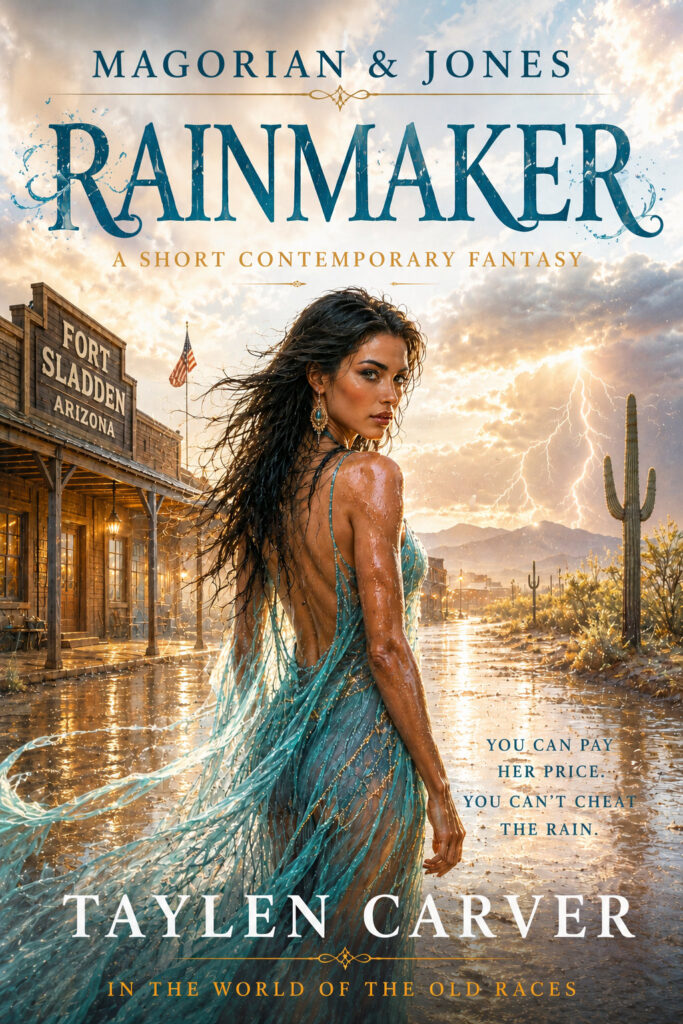
So I sat down with an AI image generator—not to have it magically produce a finished cover, but to work with it much as I’d work with a human artist. There were plenty of false starts and lots of iterations as I refined the concept, adjusted the mood, changed details, and slowly nudged it toward the image I’d always had in my head. Eventually, we arrived here. Rainmaker’s new cover.
I love it.
It captures the atmosphere of the story far better than the original ever could: the rain-soaked Arizona main street, the gathering storm, and, of course, the siren who has come to collect what she’s owed. I think it finally looks like the story that’s been sitting in my imagination all these years.
If you’ve already read Rainmaker, I’d love to know what you think of the new cover. You can pick up a copy here.
It’s completely free, and although it follows The Memory of Water in the Magorian & Jones timeline, you don’t need to have read the novel first. It stands perfectly well on its own.
And judging by the reviews readers have left over the years, it seems to have made a few people curious about what happened next—which was exactly what I’d hoped.
.
.
Newly Released: After the Quieting. — Veilbound — Firebird Omnibus