Fantasy readers often talk about influences. You can hardly discuss the genre for five minutes before someone mentions Tolkien. Usually with good reason.
But lately I’ve noticed something interesting. More readers are wandering further back into fantasy history, digging through Project Gutenberg and old used bookstores, and discovering something unexpected:
Fantasy did not always look the way it does now.
In fact, if you traveled back to the late nineteenth century and asked a fantasy reader what the future of the genre would be, there is a good chance they would never have guessed we’d end up with sprawling maps, dark lords, magical artifacts, and farm boys destined to save the world.
Not because those things are bad. Just because there were many different roads fantasy might have taken.
Tolkien’s road happened to become the highway.
The others are still there, half-hidden under the weeds.
The Dreamers
One of the strangest discoveries for modern readers is how dreamlike much early fantasy can feel. Take Lord Dunsany.
His stories often read less like novels and more like myths somebody dreamed after falling asleep beside a fire. Kingdoms rise and vanish. Gods wander through mortal affairs. Strange cities appear briefly and are never seen again.
Modern fantasy often values consistency and detailed worldbuilding. Dunsany was after something else entirely. Wonder.
Reading him feels less like visiting a fantasy world and more like glimpsing one through a crack in a door.
George MacDonald worked in a similar territory. His stories frequently operate according to dream logic rather than plot logic. Things happen because they feel right rather than because they fit neatly into a flowchart.
For readers raised on modern fantasy, the experience can be surprisingly refreshing. Or bewildering. Sometimes both.
The Adventurers
Another forgotten branch of fantasy grew out of adventure fiction. This is where H. Rider Haggard enters the picture. Today he’s best known for King Solomon’s Mines and She, but his influence stretches far beyond those books.
Lost cities. Ancient civilizations. Hidden kingdoms. Immortal rulers.
Long before fantasy roleplaying games sent heroes into forgotten ruins, Haggard was already sending adventurers into mysterious lands filled with wonders and dangers.
Reading him today, you can often see the DNA of fantasy adventure still wriggling around beneath the surface. You may also discover why modern editors occasionally save authors from themselves.
Victorian adventure fiction was not always subtle.
The Weird Ones
Some writers wandered into territory that still feels unusual even now.
Arthur Machen specialized in stories suggesting that strange realities lurk just beneath the ordinary world. Ancient powers, hidden mysteries, forgotten truths—his work helped shape much of what we now think of as weird fiction.
Then there is Hope Mirrlees. If you’ve never heard of Lud-in-the-Mist, you’re not alone. For decades it was one of fantasy’s best-kept secrets. Yet modern writers keep rediscovering it and passing it around like a treasured map.
The novel combines fairy lore, politics, commerce, social customs, and quiet humor in ways that feel startlingly modern. Every few years another generation of readers discovers it and wonders why everyone isn’t talking about it. Then they become part of the next wave of people talking about it.
The Nonsense Makers
Fantasy also had a much sillier branch. Lewis Carroll’s work is often filed under children’s literature, which somehow disguises how wonderfully strange it actually is. The worlds of Wonderland and the looking-glass are built from wordplay, paradoxes, jokes, and dream logic.
They remind us that fantasy does not always need ancient prophecies and magical wars. Sometimes it can simply be weird. In fact, some of the most enduring fantasy has been gloriously weird.
So Why Are Readers Rediscovering These Books?
Partly because modern fantasy has become broad enough to appreciate them.
For years, much of the genre existed in Tolkien’s shadow. Then it spent time in the shadow of grimdark fantasy. Readers often looked for books that resembled whatever was currently popular.
Today the landscape is far more diverse. Readers happily move between epic fantasy, cozy fantasy, mythic fantasy, dark fantasy, historical fantasy, and every combination in between. That naturally leads to curiosity.
If fantasy can be all these different things now, what other forms has it taken in the past? The answer, it turns out, is quite a lot.
Many of these older works are now freely available through Project Gutenberg (all the links in this post link to that site) and other digital archives. Books that once required hunting through used bookstores can now be downloaded in seconds.
The result is a kind of literary archaeology. Readers are rediscovering buried cities beneath the foundations of modern fantasy. And occasionally they find treasures that still shine.
The Roads Not Taken
What fascinates me most is not whether these books are better than modern fantasy. Some are. Some aren’t.
The real fascination is seeing how many possibilities existed before one particular vision of fantasy became dominant.
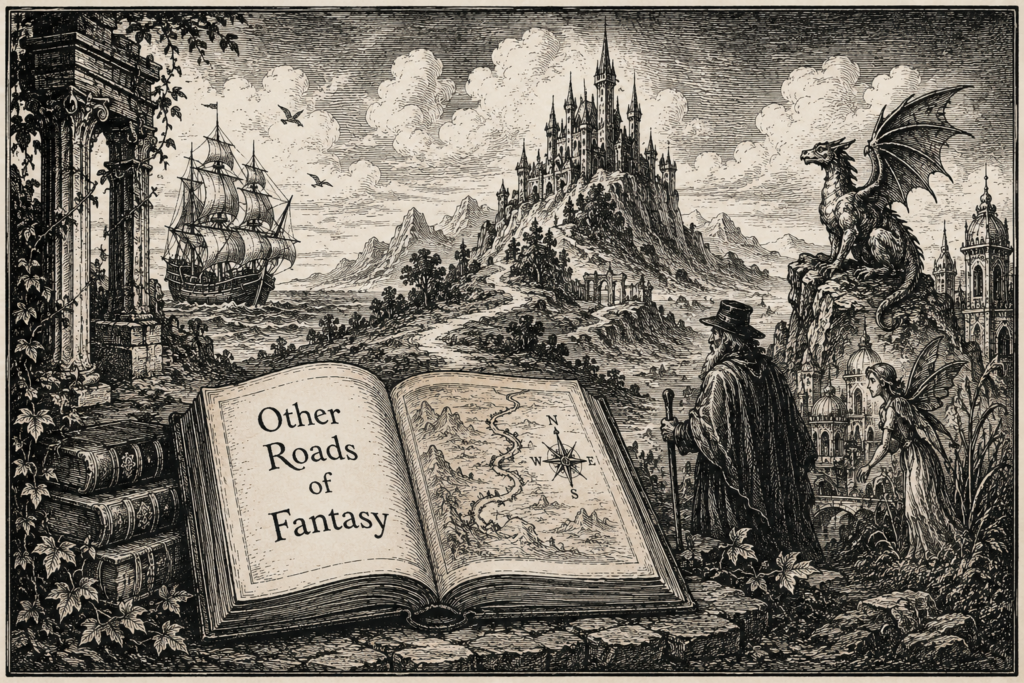
Fantasy history wasn’t a straight line leading inevitably toward The Lord of the Rings. It was a forest of branching paths. Some led to dream kingdoms. Some led to lost worlds. Some led to fairy markets.
Some led somewhere so strange we’re still not entirely sure how to describe them.
And every so often it’s worth leaving the main road behind and seeing where those forgotten paths go.

.
.
Newly Released: Street Magic IV — After the Quieting. — Veilbound — Firebird Omnibus