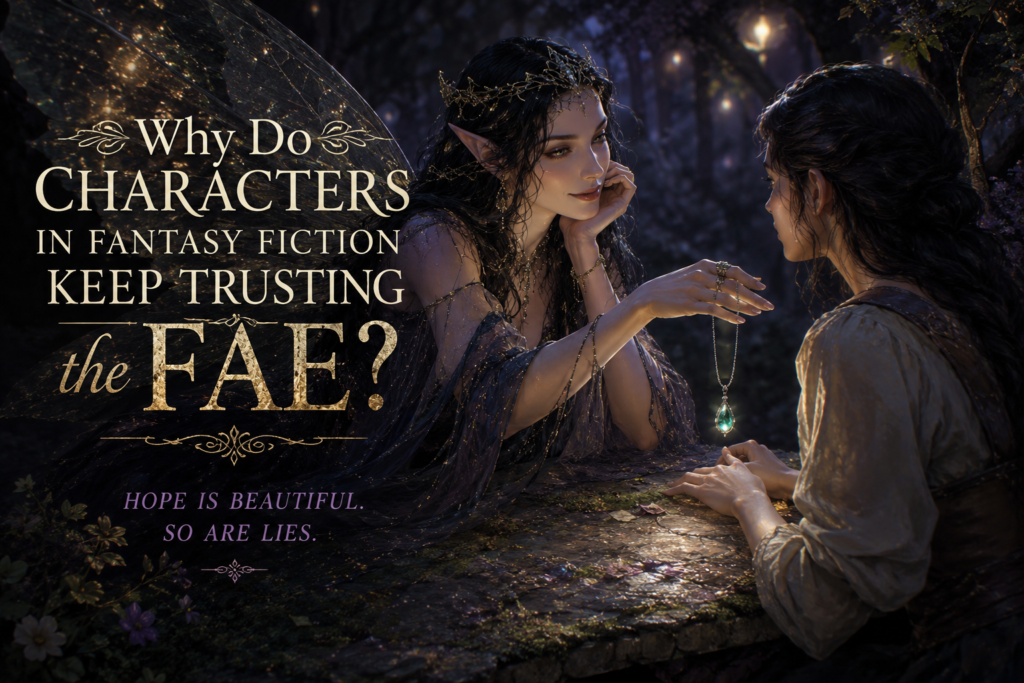
Fantasy readers love to criticize characters who trust the fae. A beautiful stranger appears in a moonlit forest. They offer help. They offer answers. They offer exactly what the protagonist needs.
And readers immediately start shouting.
“Don’t do it!”
“Have you never read a fantasy novel?”
“Run away!”
The funny thing is that most of us are convinced we’d do better. We wouldn’t. At least, not necessarily. The reason characters keep trusting the fae isn’t because they’re stupid. It’s because the fae usually offer something humans desperately want.
Hope.
And hope is one of the hardest things in the world to resist.
Because the Alternative Is Worse
Many fantasy protagonists aren’t choosing between a safe option and a dangerous option. They’re choosing between disaster and a chance. The kingdom is falling. The plague is spreading. The villain is winning. Someone they love is dying. Then the fae arrive.
Maybe the fae are dangerous. Maybe everyone knows they’re dangerous. But when all other paths lead to failure, a dangerous possibility starts looking very attractive, while the alternative is far worse.
Because the Fae Often Tell the Truth
One of the most unsettling things about many versions of the fae is that they don’t actually need to lie. Humans tend to assume that truthfulness and trustworthiness are the same thing. They aren’t.
A fae can tell the truth. A fae can keep every promise. A fae can honor every agreement. And a human can still end up miserable.
The problem is that humans and fae often mean different things when they use the same words. Both parties may walk away believing they understood the conversation. Unfortunately, only one of them is correct.
Because Humans Are Optimists
Or perhaps “optimistic” is a polite way of saying we all think we’re smarter than we are. Every generation hears the warnings. Every generation believes it will be the exception. The hero doesn’t think they’ll be tricked.
They think they’ll spot the trap. They don’t think they’ll make the mistake everyone else made. They think they’re clever enough to avoid it. History suggests otherwise.
Because the Fae Are Fascinating
The fae are dangerous. They are mysterious, and powerful. They possess knowledge humans don’t have and magic humans can’t understand. If they were merely terrifying, most people would avoid them. But they’re not merely terrifying.
They’re fascinating.
Curiosity has led humans into trouble for as long as there have been humans. The fae simply provide a particularly spectacular version of that trouble.
Because the Fae Offer Hope

This is probably the most important reason of all. The fae don’t just offer an alternative.
They offer a solution. The impossible becomes possible around them. The dying can be saved. The lost can be found. The curse can be broken. The enemy can be defeated. The future can be changed.
When someone offers exactly the thing you need most, it becomes much harder to remember all the reasons you shouldn’t trust them. Hope has a way of drowning out caution.
Because They Look Human
This may be the most human mistake of all. People instinctively assume that anything that looks human thinks like a human. The fae often exploit that assumption. Or perhaps they don’t even need to. Humans do the work for them.
If something looks human, smiles like a human, speaks like a human, and appears to share our emotions, we naturally assume we understand it. But appearance and motivation are not the same thing.
Many fantasy settings are built around the uncomfortable realization that the fae may look human while remaining profoundly alien. And that’s where the danger lies.
Because They Offer Recognition
This is the reason I think gets overlooked most often. Many fantasy protagonists are isolated. They are outsiders. They’re misunderstood, ignored, dismissed, or underestimated. Then someone notices them. The fae see them. The fae take an interest in them. By their interest, the fae are telling them they matter.
That’s an incredibly powerful thing to hear. Everyone wants to feel seen. Everyone wants to believe they’re special. And the fae are often very good at saying exactly what a person most wants to hear.
The Halo Effect
There’s another factor at work as well. Psychologists call it the “halo effect.” It’s our tendency to assume that attractive people possess other positive qualities. We unconsciously associate beauty with intelligence, honesty, kindness, competence, and trustworthiness.
The association isn’t rational. But it is remarkably common. Which is unfortunate, because the fae are rarely described as ordinary-looking. They are beautiful. Extraordinarily beautiful. The kind of beautiful that makes people forget themselves, and overlook warning signs. The kind of beautiful that makes people believe impossible things.
Combine supernatural beauty with an offer of hope and a solution to an impossible problem, and suddenly centuries of warnings become surprisingly easy to ignore.
So Why Do Characters Keep Trusting the Fae?
For the same reason humans trust all sorts of dangerous things.
- Because they want to believe.
- Because they’re desperate.
- Because they’re hopeful.
- Because they’re curious.
- Because they’re lonely.
- Because someone is offering exactly what they need at exactly the moment they need it.
The fae may be ancient, powerful, and utterly inhuman. But the real reason these stories keep working is because humans remain stubbornly, wonderfully human. And that means that no matter how many warnings we hear, we’ll always be tempted to listen when someone offers us the impossible.
.
.
Newly Released: Street Magic IV — After the Quieting. — Veilbound — Firebird Omnibus