Lately I’ve noticed a recurring conversation among fantasy readers. People say they’re tired of sprawling epics. They’re looking for standalone novels. They miss “old-school fantasy.” They want stories that don’t require a spreadsheet to keep track of who’s related to whom.
The obvious conclusion is that readers want simpler fantasy. I’m not convinced that’s true.
I think readers still love enormous worlds. They just don’t want to pay the entire admission price before they’ve decided whether they want to stay.
Every fantasy novel asks something of the reader. That’s part of the appeal. You’re entering a place where the rules are different, history matters, and everyone insists on having names with at least three apostrophes.
The trouble is that modern fantasy sometimes asks for too much, too soon. Open a new epic fantasy and you can find yourself juggling six kingdoms, four religions, a dozen noble houses, two magic systems, and a family tree that looks like someone dropped spaghetti on a map.
There’s a moment—especially if you’ve read fantasy for years—where you sigh inwardly and think: “Oh, no. Here we go again.” Time to memorise another cast of fifty. Another map. Another glossary. Another thousand years of history.
Some readers genuinely enjoy that process. Or do they? I’m beginning to wonder whether readers don’t actually enjoy learning a new fantasy world. Perhaps what they really enjoy is having learned it.
Once you’re familiar with Middle-earth, you don’t spend your time wondering who Aragorn is or where Rivendell is. You simply enjoy being there. The work has already been done.
That’s immersion.
Starting a brand-new fantasy series means paying that cost all over again.
I was reminded of this while reading Guy Gavriel Kay’s The Lions of Al-Rassan. It struck me how gentle the onboarding was. Kay doesn’t begin by asking you to memorise the political history of every kingdom or the theological differences between competing faiths. Instead, he introduces people. Scenes. Relationships. Conflicts.
The world expands naturally because the story expands naturally. Before long you’re navigating an incredibly rich setting—but you never felt as though you’d been handed an exam on page one. That, to me, is masterful storytelling.
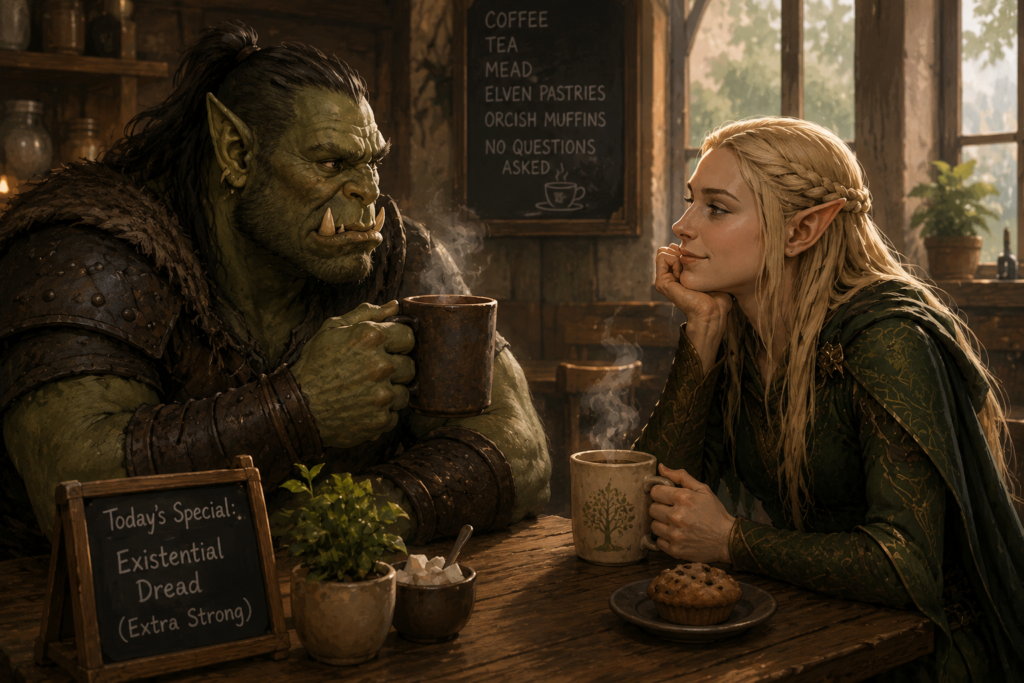
It also made me think about the recent explosion of cozy fantasy. Perhaps part of its appeal wasn’t simply lower stakes. Perhaps readers were also looking for lower cognitive load.
Of course, not all cozy fantasy delivers that. Some books promise tea shops and cinnamon buns, yet quietly expect readers to absorb an epic-scale world humming away just outside the café window.
The emotional stakes may be cozy. The information density isn’t.
Which may explain some of the backlash the genre has received. Readers came looking for comfort and instead found homework.
Tolkien, interestingly enough, understood this distinction decades ago. Middle-earth is one of the richest fantasy worlds ever created, yet remarkably little of it is required reading.
To follow The Lord of the Rings, you don’t need to know the history of Númenor, the genealogy of Gondor’s kings, or the details of the First Age. Most of that is there if you want it. It isn’t required if you don’t.
The essential story is surprisingly straightforward: there’s a Ring, it belongs to the Dark Lord, and it must be destroyed before he gets it back.
Everything else enriches the experience without blocking your way into it.
Even the famous Council of Elrond—the novel’s largest burst of exposition—arrives only after Tolkien has spent hundreds of pages making you care about Frodo and his companions. He earns the right to explain.
I sometimes wonder if modern fantasy authors feel anxious that readers will become confused unless everything is explained immediately. Ironically, that anxiety often creates the very confusion it’s trying to avoid.
Readers don’t remember encyclopedias. They remember stories.
Introduce me to one compelling character and I’ll happily learn about their world. Introduce me to twenty-seven proper nouns before I’ve met anyone I care about, and my eyes begin searching for the nearest exit.
Perhaps that’s the real lesson. Readers don’t want smaller fantasy worlds. They want easier ways into them. Build a world as vast and ancient as you like. Fill it with forgotten empires, complicated politics, lost languages, and centuries of history. Just don’t ask me to memorise it all before Chapter Two.
Invite me inside first.
Once I fall in love with the world, I’ll happily spend years exploring every corner of it.

.
.
Newly Released: Street Magic IV — After the Quieting. — Veilbound — Firebird Omnibus