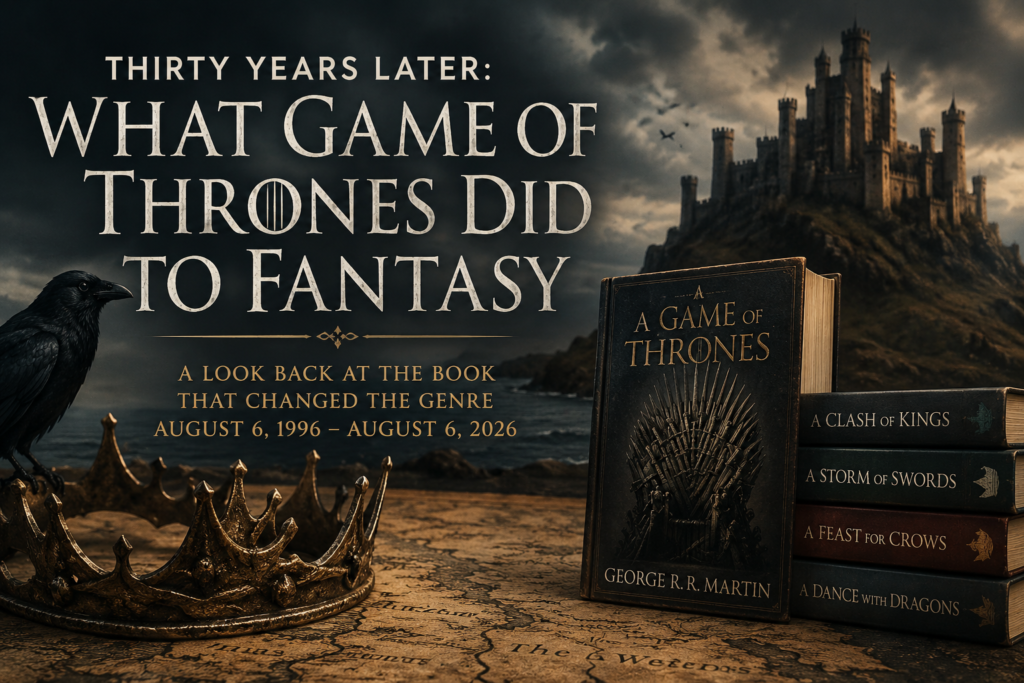
The thirtieth anniversary of Game of Thrones is this year, on August 6. George R. R. Martin published the book in 1996. And fantasy has arguably never recovered.
That sounds harsher than I mean it. Mostly. Because I have mixed feelings about the series. Deeply mixed feelings. The sort of mixed feelings usually reserved for relatives who borrow your tools and return them sticky.
On one hand, the books are ambitious, immersive, politically intricate, and frequently brilliant. Martin created a world that feels genuinely historical. Not in the “everyone wears brown and smells faintly of despair” sense modern fantasy sometimes mistakes for realism, but in the sense that institutions, dynasties, grudges, and bad decisions all collide with terrifying momentum.
The world of Westeros feels like it existed before the story began and will continue grinding onward long after the heroes are dead. And the heroes absolutely will die.
Possibly at dinner.
But I also think the success of Game of Thrones changed fantasy in ways we’re still sorting out three decades later. Some good. Some… less good.
Martin Didn’t Invent Grimdark
Fantasy history sometimes gets rewritten as though Martin invented morally gray fantasy in 1996, emerging from the wilderness carrying a severed crown and a manuscript stained with the tears of idealists.
Not quite. Fantasy had already gone dark long before Westeros arrived. Stephen R. Donaldson’s Lord Foul’s Bane appeared in 1977, and Thomas Covenant made most fantasy protagonists look like emotionally stable golden retrievers by comparison.
Those books were bleak. Intentionally bleak. They used fantasy less as escapism and more as psychological confrontation.
Covenant may simply have arrived too early. While Martin hit at precisely the right cultural moment. By the mid-90s, readers were ready for fantasy that distrusted heroism, questioned institutions, and treated power as corrosive rather than noble. Cynicism had become culturally familiar. Fantasy audiences were primed for noir. Martin made that darkness accessible. That was the real breakthrough.
The Politics Felt Real
What made Game of Thrones feel revolutionary wasn’t merely the violence or moral ambiguity. Fantasy already had violence. Fantasy already had antiheroes. Martin’s innovation was political texture.
Competing claims. Fractured loyalties. Dynastic instability. Consequences rippling outward through entire kingdoms. People make terrible choices in these books not because they’re villains, but because they’re trapped inside systems larger than themselves. Everyone believes they’re justified. Everyone is partially wrong. History keeps rolling forward anyway.
That felt startlingly fresh in mainstream fantasy at the time. The story wasn’t arranged around destiny. It was arranged around pressure.
I Still Hate “Ser”
Yes, this is petty. No, I will not be taking questions. The use of “Ser” instead of “Sir” has always yanked me out of the story every single time I encounter it. I understand why Martin did it. Fantasy writers often tweak familiar language to signal that this is not technically medieval England with dragons stapled onto it.
But “Sir” is invisible. Readers absorb it without friction, the same way they absorb “said.” “Ser” calls attention to itself every single time. It becomes typography instead of immersion.
Fantasy sometimes overestimates how much novelty improves worldbuilding. Decorative spellings, apostrophes breeding uncontrollably across the landscape, aggressively invented terminology…all of it can become strangely artificial.
Oddly enough, Tolkien often showed more restraint here. Much of Middle-earth feels ancient precisely because the language feels grounded rather than desperately exotic.
The Books Are Too Long
There. I said it. Somewhere, a thousand furious Reddit threads just burst into flame.
But I think Martin occasionally mistakes expansion for depth. The early books balance intrigue, reversals, momentum, and character exceptionally well. As the series widens, though, the narrative begins to sprawl faster than it advances.
More POVs. More houses. More history. More subplots. More pages capable of inflicting blunt force trauma if dropped from a shelf. At some point, the story starts accumulating instead of driving forward.
And I suspect modern fantasy is already reacting against that excess. Readers increasingly seem drawn toward:
- tighter stories
- standalones
- smaller casts
- cleaner momentum
- adventure fantasy
- emotionally sincere fantasy
- worlds that don’t require genealogical software to navigate
Immersion is wonderful. But narrative velocity matters too.
What Game of Thrones Changed
After Game of Thrones, fantasy shifted dramatically.
- Heroes became suspect.
- Idealism became naïve.
- Politics became mandatory.
- Death became a marketing feature.
- Hope itself started looking embarrassingly unfashionable for a while.
And for years, the industry chased that tone relentlessly.
But thirty years later, the pendulum may finally be swinging back. Readers still want complexity. They still want consequences and believable worlds and characters who occasionally make catastrophically bad decisions while convinced they’re being clever. But there’s also renewed hunger for wonder. For heroism. For quests. For fantasy that remembers awe matters as much as brutality.
That may ultimately be the strangest legacy of Game of Thrones. Not that it made fantasy darker. But that, after decades of darkness, fantasy readers are rediscovering why they fell in love with the genre in the first place.
.
.
Newly Released: Street Magic IV — After the Quieting. — Veilbound — Firebird Omnibus
I couldn’t agree more! Made up words and unpronouncable names don’t improve the story. They’re detractors! As for game of thrones, it started off as a great story. BUT…the deeper you got into the story the more depressing it became. When he finally killed off the last of of “good” people, i put the book down and never looked back. Life is tough enough without depressing stories! I’m a John Wayne fan. If the good guys can’t win in the end, i ain’t interested. Hmmm… same applies to sex scenes that last for multiple chapters. I’m old enough I know how to do that stuff. Don’t need to read it.
Sorry! Sometimes I get carried away…
Thanks for your thoughts and allowing readers to comment.
Later. Joe…
Thanks, Joe. I think there is a change in the wind, in publishing, just stirring. Upbeat fiction might become popular again. Which would be very nice.
Taylen.