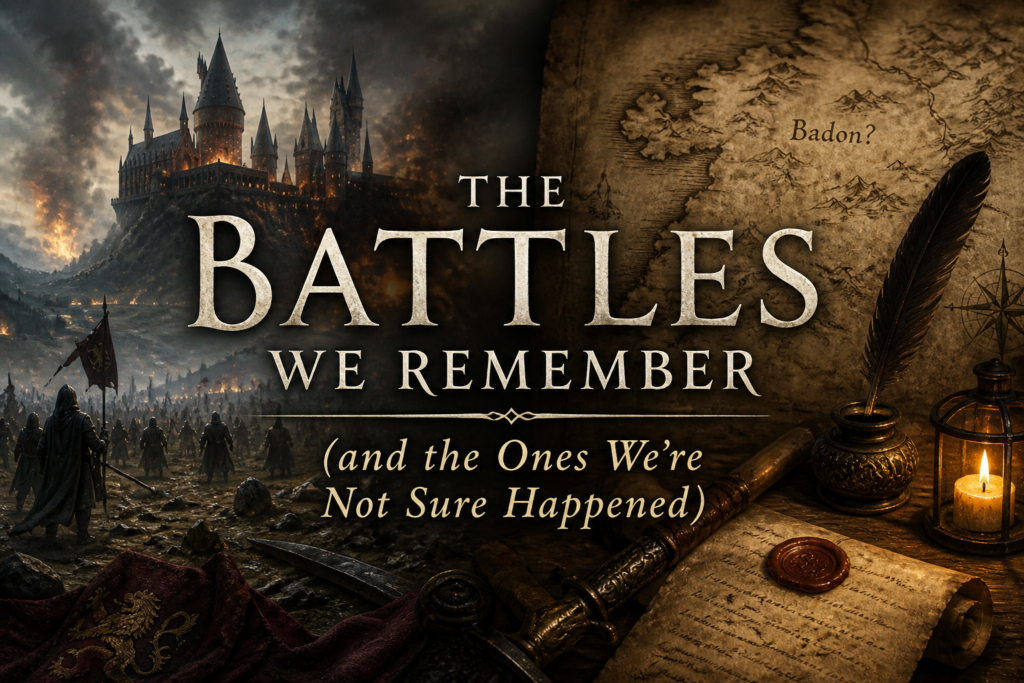
It’s May 2nd. Which—if you’re the sort of person who keeps track of these things—is the anniversary of the Battle of Hogwarts. This is, when you think about it, slightly odd.
Not the battle itself—fantasy is absolutely full of last stands, desperate defenses, and the general expectation that if you gather enough named characters in one place, something explosive will happen. What’s odd is that this one comes with a date. A specific, repeatable, “mark it on your calendar” kind of date. The sort of thing you could, in theory, commemorate annually with cake, or solemn reflection, or a rewatch that starts out lighthearted and ends with you staring into the middle distance.
Most fantasy battles don’t get that treatment.
The Ones That Feel Like They Should Have Anniversaries
There are plenty of battles that feel as though they ought to come with engraved plaques and awkward public ceremonies. Tolkien, in particular, writes as if he fully expects future historians to argue about the weather conditions.
Take the Battle of Helm’s Deep, or the Battle of the Pelennor Fields, or even the Battle of the Five Armies. These feel like history. Not just story, but something that happened to people who then went on to argue about it in taverns for the next fifty years.
And yet, most readers couldn’t tell you the exact date of any of them without checking an appendix.
Which is interesting, because it suggests that what makes a battle feel important isn’t whether we can pin it to a calendar. It’s whether it feels like the kind of event people would remember. The kind that reshapes a world, or at least leaves a permanent dent in it.
An anniversary is just the formal version of that instinct.
The Ones That May—or May Not—Have Happened at All
And then we have the other end of the spectrum: the battles that exist in a sort of historical fog.
The classic example here is the Battle of Mount Badon. It appears in a single early source. It may have happened. It may have been exaggerated. It may have involved entirely different people than the later legends claim. We’re not even entirely sure where “Badon” was, which is usually considered a helpful detail when discussing a battlefield.
And yet, it looms large.
Badon is one of those hinge points in the Arthurian tradition; the great victory that holds back the dark for a while longer. It’s less a recorded event than a narrative necessity. Something that must have happened, because the story requires it.
Fantasy loves this kind of gap.
Give a writer a well-documented battle, and they’ll research it. Give them a battle that might have happened somewhere on a hill no one can identify, and they’ll build an entire mythology in the space where certainty should be.
The Ones No One Would Actually Celebrate
There’s also a quieter category: the battles people remember, but would really rather not turn into an annual event with banners and speeches.
Think the Red Wedding—which isn’t technically a battle, but good luck finding anyone who forgets it…or the Battle of Winterfell. These are events that stick in the collective memory, but not in a way that invites cheerful remembrance. Commemoration implies a certain amount of pride. Or at least a tidy narrative. A sense that, in the end, this meant something clear and unambiguous.
A lot of fantasy battles are messier than that. Victory comes at a cost. Survival feels like a technicality. The story moves on, but the world is left with scars that don’t lend themselves to annual celebrations.
So Why Do We Mark Any of Them at All?
Which brings us back to Hogwarts. Why this battle? Why this date? Part of it is simply that it exists. It’s written down. It’s tied to a specific moment in a modern series with a very engaged readership. But there’s something else going on as well.
Anniversaries aren’t really about dates. They’re about stories we’ve agreed to keep telling.
In the real world, anniversaries help define identity. They take complicated, messy events and compress them into something repeatable; something you can point to and say: this mattered, and it still matters.
Fantasy does the same thing—just usually without the calendar reminder. We remember Helm’s Deep because it feels like a turning point. We remember Badon because it might have been one. We remember the Red Wedding because we wish, on some level, that we didn’t.
The anniversary is just the formal version of that memory. The scheduled retelling.
A Slightly Uncomfortable Question
Which, of course, raises a more interesting question for any fantasy world (and, conveniently, for mine as well): Which battles get remembered? Which ones get anniversaries, official or otherwise?
And which ones quietly… don’t?
History, real or fictional, has a way of smoothing over its rough edges. The battles that fit the story are commemorated. The ones that don’t are argued about, misremembered, or left to sit in the fog like Badon—half real, half legend, and entirely at the mercy of whoever tells the tale next.
If nothing else, it does make you wonder what people would be marking on their calendars a few centuries after the events of Taylen’s world.
Assuming, of course, that anyone agrees on what actually happened.
.
.
Newly Released: Street Magic IV — After the Quieting. — Veilbound — Firebird Omnibus