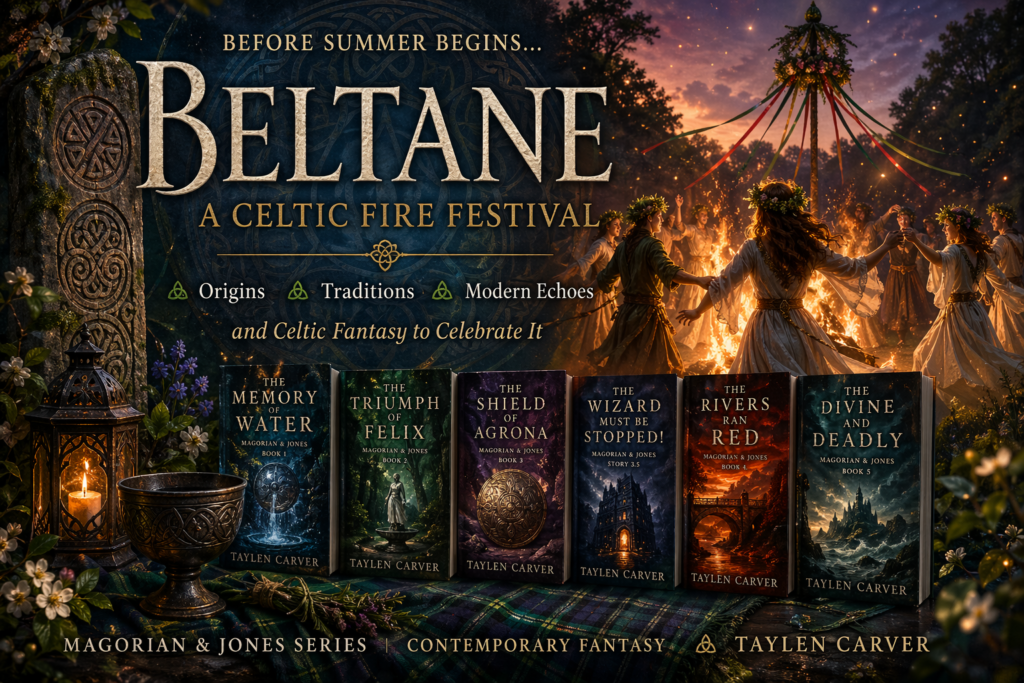
Today is the last Saturday before May 1. May 1 is Beltane, which I couldn’t let pass without a mention.
There’s a particular kind of tension that comes with a ticking clock in fantasy. Not just time is running out, but something ancient is coming, something inevitable. In The Rivers Ran Red, that looming moment was Beltane. Everything had to be resolved before it arrived. Because Beltane isn’t just a date on a calendar. It’s a threshold.
Where Beltane Comes From
Beltane (from the Old Irish Beltene) is generally understood to mean “bright fire” or “Bel’s fire.” Scholars debate whether Bel refers to a specific deity—sometimes linked to Belenus, a sun or healing god—or whether the term simply evokes the power of light itself. Either way, fire is at the heart of it.
Celebrated on May 1st, Beltane marks the beginning of summer in the old Celtic calendar. It sits opposite Samhain (November 1st), forming a seasonal axis: Samhain opens the dark half of the year; Beltane opens the light.
If Samhain is the thinning of the veil into death and memory, Beltane is the thinning into life, fertility, and transformation.
What Beltane Meant
For early Celtic communities, Beltane wasn’t symbolic—it was practical, immediate, necessary. Winter was survival. Summer was possibility. Beltane marked the moment herds were driven out to pasture, fields began to matter again, and the world tilted toward growth. But with that promise came risk. Crops could fail. Livestock could sicken. The unseen world—spirits, forces, old gods—still needed to be acknowledged.
So they lit fires. Huge communal bonfires were kindled, often on hilltops. People and cattle would pass between twin fires, or leap the flames themselves, seeking purification and protection. Ashes from the fires were scattered across fields to bless the coming harvest. Homes extinguished their hearth fires and relit them from the communal blaze—a symbolic reset, a shared beginning.
And woven through all of it was fertility. Not just in the sense of reproduction, but in the broader sense of abundance: life flourishing, boundaries loosening, energy returning.
What They Did to Celebrate
Beltane was not quiet. There was feasting, music, dancing—often around the maypole, a later but enduring symbol of intertwined life forces. Couples might slip away into the woods, sometimes forming temporary unions recognized only for the season. Flowers were gathered, doorways decorated, and thresholds marked. It was a liminal time. Rules bent. The ordinary loosened.
In many ways, Beltane was permission to step outside structure, if only briefly, and embrace something older and wilder.
Beltane Today (or, Why It Feels Distant)
These days, Beltane survives mostly in fragments. Neo-pagan traditions and reconstructionist groups keep it alive with ritual and intention, but for most people, May 1st passes unnoticed. We’ve traded seasonal thresholds for calendar quarters, agricultural urgency for climate control. And yet… the instinct is still there.
The first truly warm day. The sudden green of trees. The restless sense that something is shifting beneath the surface. That urge to open windows, to begin again, to step outside routines. We may not call it Beltane anymore. But we still feel it.
Beltane in Fantasy
Which is why Beltane works so well in Celtic-inspired fantasy. It’s not just a date—it’s a narrative device. A deadline infused with meaning. A moment when magic is heightened, when barriers thin, when consequences crystallize. In The Rivers Ran Red, Beltane wasn’t decorative. It was the fulcrum. Everything pointed toward it because, in a world shaped by older rhythms, it had to.
And that’s the real power of drawing from Celtic tradition: it brings weight to time itself.
If You Like a Little Celtic in Your Fantasy…
There’s no shortage of stories that draw from these roots, some directly, others more subtly. If you’re looking for that blend of myth, seasonality, and ancient tension, you might explore:
- The Mists of Avalon by Marion Zimmer Bradley
- Daughter of the Empire (for its ritual weight, though not strictly Celtic) by Raymond E. Feist
- The Iron Druid Chronicles by Kevin Hearne
- Juliet Marillier’s Sevenwaters series
- The Buried Giant by Kazuo Ishiguro
And, of course, a small nod to my own corner of the genre: In the cozy fantasy series, Witchtown Crossing, written as Tracy Cooper-Posey, Book Two is titled Beltane Curse. 🙂 Because some stories still know that May 1st matters.
Beltane may have faded from everyday awareness, but in fantasy—and perhaps in something deeper—it remains what it has always been; a crossing point, a fire in the dark, a promise that something is about to change.
.
.
Newly Released: Street Magic IV — After the Quieting. — Veilbound — Firebird Omnibus