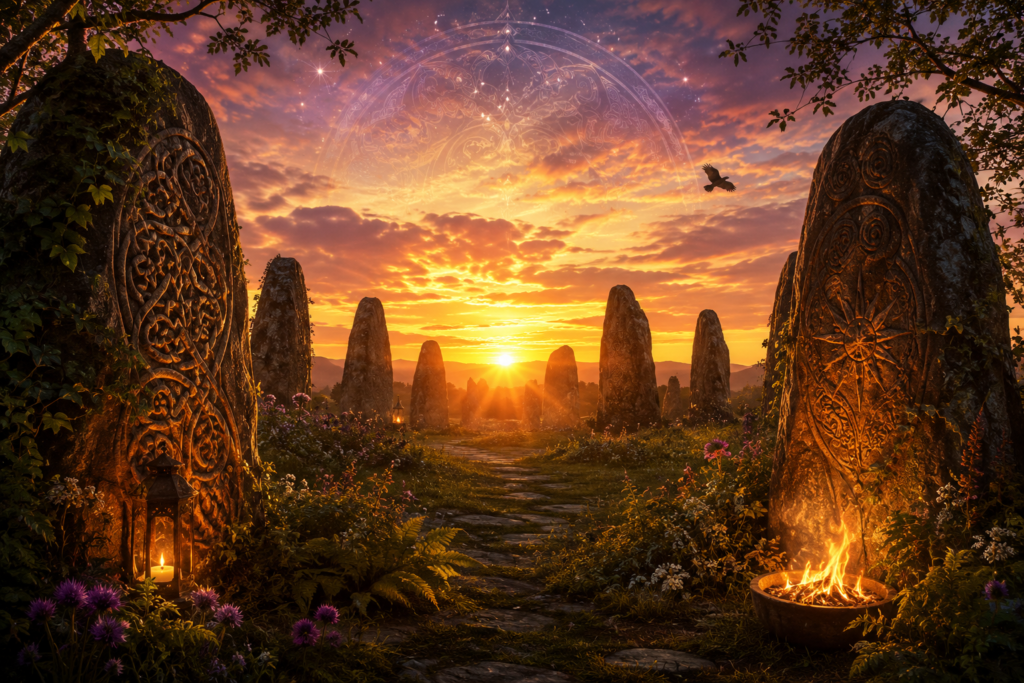
Tomorrow’s summer solstice arrives at approximately 2 a.m. here in Alberta. Which raises an obvious question.
How do they know?
Not “How do they know it’s around June 21?” That’s easy enough. Humans have been tracking that for thousands of years. Ancient peoples noticed that the sunrise gradually moved northward along the horizon each morning, then seemed to stop for a few days before heading south again. The word solstice comes from the Latin solstitium — “sun stands still.”
But how do modern astronomers know that the solstice occurs at 2:42 a.m. rather than 1:42 or 3:42?
The answer is that the solstice is not actually a day. It’s a moment.
The summer solstice occurs at the exact instant when the Sun reaches its northernmost position relative to Earth’s equator. In astronomical terms, it’s the moment the Sun reaches its maximum declination north of the celestial equator. Earth’s tilt is about 23.4 degrees, and at the solstice the Northern Hemisphere is leaning toward the Sun as far as it possibly can.
Nowadays astronomers can calculate the positions of Earth and Sun with extraordinary precision. They know Earth’s orbit, its tilt, and its motion through space. The “official” solstice is simply the instant their calculations show that the Sun has reached that northernmost point before beginning its slow journey southward again.
Which means the solstice can happen at any hour.
It might occur at dawn. It might occur at noon. It might occur while you’re asleep and the cat is knocking books off the nightstand.
The sunrise celebrations are therefore symbolic rather than exact. When crowds gather at Stonehenge to watch the dawn on the summer solstice, the actual astronomical moment may have happened hours earlier or may not arrive until later that day. The sunrise is simply a convenient and dramatic way to celebrate the event.
Fantasy readers may recognize a familiar pattern here.
In modern fantasy — especially Celtic-inspired fantasy — solstices, equinoxes, and cross-quarter days often function as magical boundaries. They are the hinges on which the year turns. Portals open. Enchantments strengthen. Ancient powers stir. The Summer Court reaches its height.
Real-world traditions often worked much the same way.
People were rarely concerned with the exact second of the solstice. They cared that the turning of the year had arrived. Celebrations might last several days. Bonfires were lit. Feasts were held. People gathered to mark the season’s high point.
Which is fortunate. Imagine trying to hold a midsummer festival at 2:42 in the morning. Even the fae might object to that scheduling.
Still, I rather like knowing that behind all the mythology, folklore, and fantasy lies a precise celestial event. Somewhere, deep beneath the stories, there really is a moment when the Sun reaches the top of its yearly arc and begins its long journey back.
The ancients watched for it from hilltops and stone circles. Today we calculate it with mathematics. And somehow both approaches seem appropriately magical.
.
.
Newly Released: Street Magic IV — After the Quieting. — Veilbound — Firebird Omnibus