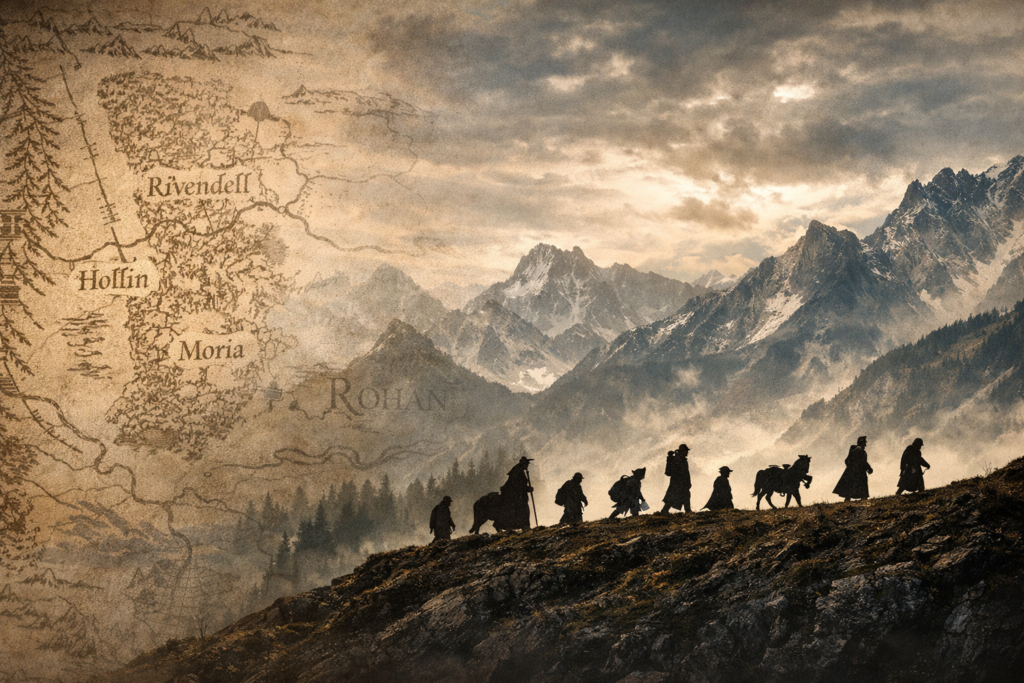
One of the strangest things about fantasy is that worlds which are supposedly enormous often feel tiny.
A map will tell us there are three kingdoms, two mountain ranges, a haunted forest, a desert, six lost cities and at least one tower occupied by a man with serious boundary issues. Technically, the world is huge.
Yet somehow it all feels as though it is only a brisk ride apart.
The hero leaves home. There is a forest. Then a city. Then the mountains. Then, apparently, the end of the world.
By contrast, Middle-earth feels vast.
Not because it is larger than every other fantasy world. Plenty of fantasy worlds are technically bigger. But Tolkien makes us feel the size of it.
The trick is distance.
Fantasy Maps Are Lying To You
Fantasy maps have the same problem as those diagrams of the Earth and the Moon.
You may have seen the corrected version circulating recently: most illustrations show the Moon hovering just above the Earth, as though it could be reached with a determined ladder and a regrettable disregard for health and safety. In reality, the distance is so great that all the planets of the solar system could fit between the Earth and the Moon.
Fantasy maps do the same thing. We look at a quarter-inch on the page between two labels and think, Ah yes, a pleasant afternoon’s ride.
Then Tolkien quietly informs us that the Fellowship left Rivendell, walked south along the Misty Mountains for many days, and still had not reached the difficult part. In the film, Gandalf says they must follow the mountains for forty days before they can cross.
Forty days.
Forty days is not “just over there.” Forty days is hundreds of miles (even at a slow crawl of ten miles a day). Forty days is enough time to wear out boots, lose your temper with your companions, begin to hate the weather personally, and forget what dry socks feel like.
Suddenly that quarter-inch on the map is not a short walk through scenic countryside. It is an immense empty land.
Tolkien Makes You Walk The Miles
In the book, Tolkien does not merely tell us that the Fellowship travels. He makes us feel it. After leaving Rivendell, the Fellowship spends weeks moving south along the western side of the Misty Mountains. They reach Hollin—the old elvish land of Eregion—more than two weeks later.
And almost nothing happens. There are no battles. No great revelations. No dramatic speeches atop a cliff while the music swells.
Instead there is weather. Rough ground. Empty country. Mountains always on the left. The sense that they are becoming steadily further from home.
That is why Middle-earth feels enormous. Tolkien is willing to spend pages on the spaces between the exciting bits.
Most fantasy writers, understandably, do not. They write what might be called the “tourist brochure version” of travel. The hero crosses half a continent in three paragraphs: They passed through a gloomy forest, a market town, two villages and a mountain pass. After several weeks, they reached the capital.
You know the distance has happened. But you do not feel it. You remember the destinations, not the miles between them.
Film Makes The World Smaller Again
And then film compresses it even further. Books can linger on weather, hunger, sore feet, silence and the peculiar despair of discovering there is still another week of road ahead. Film cannot.
So cinema has developed its own visual shorthand for “they have travelled a long way”:
- the party walks in silhouette along the top of a ridge
- everyone wears cloaks
- someone pauses dramatically and looks into the distance
- the music swells to imply that geography has occurred
We all know the shot. The Fellowship appears in single file against the skyline, tiny against the mountains, while Howard Shore’s score rises magnificently and everyone gazes meaningfully at the horizon.
It is beautiful. It also tells us almost nothing about distance. Thirty seconds later, they have arrived.
The world feels smaller because the journey has been reduced to a montage. The mountains are no longer something you have trudged beside for fifteen miserable days. They are simply the backdrop to a particularly attractive walking shot.
Which is not really the film’s fault. It has perhaps thirty seconds to suggest what Tolkien took chapters to build. But something is lost.
I Know, I Know, I’m Talking About Tolkien Again
At this point I should probably apologise for once again waving The Lord of the Rings around like the answer to every question about fantasy.
But really, Tolkien got so much right.
There is a reason he is called the father of modern fantasy. He did not merely invent elves with better cheekbones and an unfortunate tendency to sing at people. He understood how worlds work.
He understood that a map is not enough. A world only feels real when there is distance between places, when travel takes time, when the land itself matters.
That is a surprisingly difficult thing to do. It is an advanced writing skill, and not every author can manage it. No, not even bestselling authors. Many writers can invent a kingdom. Far fewer can make you feel what it is like to spend fifteen wet, miserable days crossing it.
The Spaces Between The Places
This may be the real reason Middle-earth feels larger than so many fantasy worlds. Not because Tolkien invented more kingdoms or drew a bigger map, but because he cared about the spaces between the names on the map.
He understood that distance is not measured in miles. It is measured in time. In weather. In boredom. In the number of days the mountains remain on the horizon and never seem any closer.
A world feels larger when it takes effort to cross. A road is more frightening when the next town is six days away. A mountain range is more imposing when you have spent two weeks walking beside it and still have not found a way through.
And perhaps that is why Middle-earth still feels so vast. Tolkien did not just show us the map. He made us walk it.
So now I am curious: have you read a fantasy novel where the distance felt real?
Not merely where the author told you the characters had travelled a long way, but where you felt the miles yourself; the weather, the exhaustion, the sheer scale of the world. Because when a writer can do that, the story changes. The world becomes larger, stranger, and much harder to leave behind.

.
.
Newly Released: Street Magic IV — After the Quieting. — Veilbound — Firebird Omnibus
For a world that understands distance – The Deed of Paksennarion by Elizabeth Moon. Actually, any of the books by Elizabeth Moon. She is concerned with how far you can march an army in a day’s travel, how you supply said army, how you choose routes.
Amazingly, that’s the book I’m reading right now. Well, The Sheepfarmer’s Daughter is what I’m reading. And yes, there are pages of descriptions about towns and roads and more towns… 🙂
Taylen