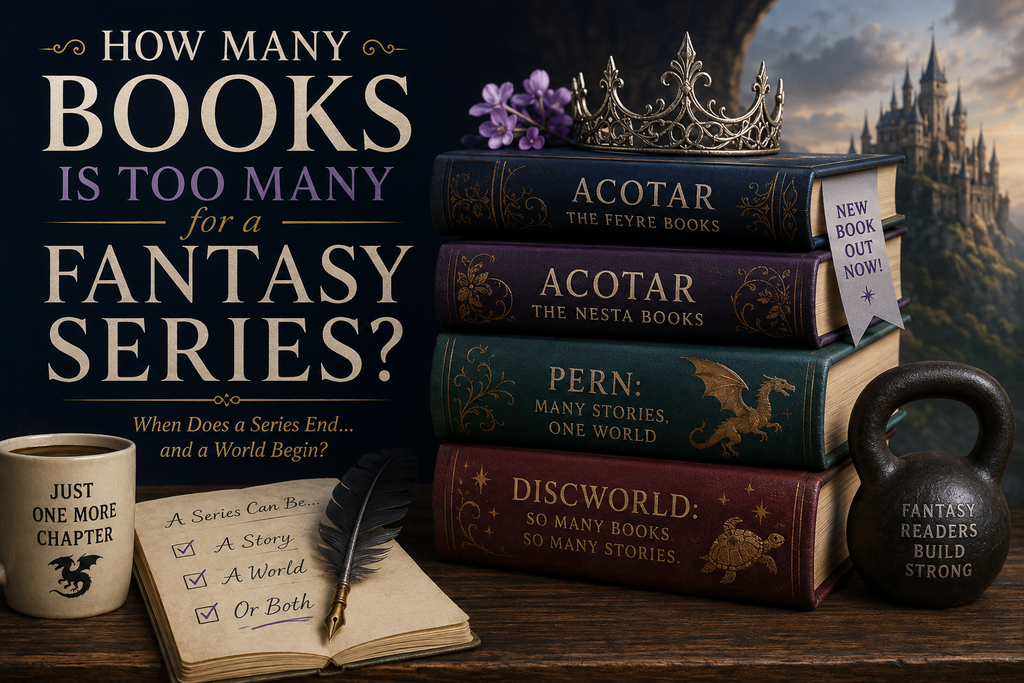
Sarah J. Maas has a new A Court of Thorn and Roses (ACOTAR) book coming out—or it’s just out, depending upon exactly when you’re reading this. Apparently this is An Event. There were midnight launch parties at my local Indigo. I heard the squeals from here.
Whatever you might think of Maas, ACOTAR, or the genre now known as romantasy—a word I personally feel should be taken quietly behind the woodshed and put out of its embarrassing misery—there’s no denying the extraordinary following she has built. Readers don’t merely buy these books. They anticipate them. They collect multiple editions of them. They gather at midnight to obtain them as soon as humanly possible.
And the books themselves are becoming substantial enough that carrying multiple editions may qualify as resistance training.
Which got me wondering about something. Just how long can a fantasy series get before we have to stop calling them a series and start calling them a lifestyle choice?
Maas’s A Court of Thorns and Roses series isn’t actually terribly long by fantasy standards. There are five published books so far, one of which is a novella. Another novel is due by the end of the year, and a sixth novel in 2027. Even six books is hardly excessive in a genre where trilogies have been known to reproduce when left unattended.
Of course, this being fantasy, counting the books doesn’t tell you very much. Some of the later ACOTAR novels are enormous. A Court of Silver Flames is somewhere around 750 pages, depending upon the edition. These are not books you casually toss into your handbag before leaving the house. The premium editions I’ve seen in bookstores could be incorporated into a perfectly respectable strength-training program.
Drop one on your foot and you’ll forget all about whatever Rhysand was doing.
But Maas has an enormous and enthusiastic readership, and the world she created clearly has enough depth to support more stories. So how many is too many? Because fantasy does have a bit of a series problem.
Fantasy Readers Like Their Books in Herds
Fantasy and series have always gone together. There are good reasons for that. Creating an entire secondary world is a ridiculous amount of work. You need geography, history, politics, religions, cultures, economies, languages, magic, wars, ancient grudges and preferably at least one ruined civilization whose inhabitants really should have left clearer instructions about the dangerous thing they buried under the mountain.
Having done all that, it seems rather wasteful to use the world once and throw it away.
More importantly, good worldbuilding creates more stories. You invent a neighbouring kingdom because your protagonist needs somewhere to flee in Chapter Seventeen. Then you discover that kingdom has a fascinating succession problem.
You create a minor character to deliver three lines of dialogue. The wretched creature develops a personality.
You mention an ancient war. You invent a mysterious island. And suddenly you know perfectly well what happened during the ancient war, who lives on the mysterious island, and why that minor character is going to cause catastrophic trouble approximately two novels from now.
Worldbuilding Creates Narrative Surface Area.
The bigger and richer the world becomes, the more places there are for stories to grow. Which means perhaps the problem isn’t that fantasy series become too long.
Perhaps we’re using the word series to describe several very different things.
Twelve Books Is Too Many. Except When It Isn’t.
I have some experience here. Under my Tracy Cooper-Posey name, I wrote the Once and Future Hearts fantasy romance series. Twelve novels. Plus a novella. Yes, thirteen books.
So I’m hardly in a position to stand on a chair and announce that Sarah J. Maas needs to learn restraint.
But Once and Future Hearts was always going to finish. There was an overarching story. It had a destination. Book Twelve was that destination. I wrote my way there, finished the story and stopped. That’s an important distinction.
A series can be enormous and still be a single, completed story.
The number of books isn’t particularly useful, either. Twelve 80,000-word novels contain 960,000 words. Four 250,000-word novels contain a million.
So which is the longer series?
Fantasy readers tend to count spines on the shelf, but perhaps we should be measuring these things by total word count. Or kilograms. ACOTAR may win on kilograms.
Then There Is Pern
Anne McCaffrey’s Pern books demonstrate a completely different model. There are a lot of Pern books. A lot.
But I never thought of Pern as one gigantic story that I had to read from beginning to end before I could finally discover what happened. There are distinct groups of books within it. Different protagonists. Different periods. Different conflicts. The original dragonrider stories aren’t the same story as the Harper Hall books, even though they overlap. Later books explore other characters and other periods in Pern’s history.
McCaffrey didn’t need to rebrand each group as Pern: The Lessa Cycle or Pern: Harper Hall to make that distinction obvious. Pern became bigger than any individual story told inside it.
That’s not really an endlessly continuing series. That’s a world. The individual stories can end even though Pern itself remains available for another one.
Terry Pratchett’s Discworld works similarly. Forty-one novels sounds absurd if you imagine them as a single continuing narrative. They aren’t.
You can follow the witches. The Watch. Death. Rincewind. Moist von Lipwig. There are recurring characters and consequences and connections everywhere, but nobody finished The Colour of Magic in 1983 and then spent the next thirty-two years waiting for Pratchett to finally wrap up the plot.
A world can be enormous. A plot probably shouldn’t be.
Which Brings Us to George
George R.R. Martin’s A Song of Ice and Fire is a different creature again.
I’m not going to join the Internet chorus yelling at Martin to write faster. Authors are human beings, books are difficult, circumstances change, and enormous stories can become extraordinarily difficult to control. I have considerable sympathy for that.
I also have sympathy for the readers. Because readers of A Song of Ice and Fire aren’t primarily waiting for another adventure set in Westeros. They’re waiting for the end of the adventure they already started.
That’s different. When someone buys the first novel in a fantasy series, no legal contract materializes in a puff of smoke. The author has not signed a document promising to produce Book Seven by 4:00 p.m. on a Tuesday. But I do think there is an implicit promise.
I’m going to tell you a story. And hidden inside that statement is another one: Eventually, I’m going to tell you how it ends. That’s the contract that matters.
So What Is ACOTAR Now?
This is why ACOTAR interests me. The first three novels primarily tell Feyre’s story. Then A Court of Silver Flames shifts its focus to Nesta and Cassian.
At some point, then, the question changes.
Are these still installments of the same story? Or are we now telling new stories inside the ACOTAR world? If it’s the latter, perhaps ACOTAR doesn’t need to end at all. Maybe what it needs is clearer subdivision. The Feyre books. The Nesta books. Whatever character or storyline comes next.
Publishers, of course, are unlikely to abandon a recognizable brand that has sold approximately all the books in the known universe simply because I think the taxonomy could be tidier. And I don’t particularly blame them.
But from a reader’s perspective, there’s a meaningful difference between: Here are three more books set in a world you love. and: You need to read three more books before the story you started eight years ago is finished.
Those are very different propositions. Especially when each of the books could be used to chock the wheels of a Boeing 747.
Maybe Fantasy Doesn’t Have a Series-Length Problem
I started wondering how many books are too many for a fantasy series. I don’t think there is an answer. Thirteen wasn’t too many for Once and Future Hearts, because thirteen was what the story required and then it was finished.
More than twenty Pern novels weren’t too many because Pern had become a setting capable of supporting many different stories.
Forty-one Discworld novels weren’t too many because nobody was waiting for forty-one books for a single plot to resolve.
The problem isn’t the number of books. It’s what the reader is being asked to wait for.
Perhaps we need better language.
There’s the closed series: one overarching story told across however many books it needs, with a definite ending.
There’s the open-world series: completed stories and arcs that share a setting, history and often characters, but don’t require the entire world to reach some final conclusion.
And then there’s the unfinished series: one enormous overarching narrative that continues expanding while its resolution remains somewhere on the horizon. Possibly just beyond the heat death of the universe.
That last category is where readers start getting twitchy. And I don’t think it’s because fantasy readers are impatient. Quite the opposite. Fantasy readers will happily read a twelve-book series. They’ll read twenty books. They’ll read forty-one Discworld novels and complain that there aren’t forty-two.
Readers don’t necessarily resent a series that never ends. They resent a story that never ends. That’s the distinction.
Worlds are allowed to keep growing. In fact, when they’re wonderful worlds, we desperately want them to. Tell me another story about Pern. Take me back to Discworld. Show me another corner of the world I’ve already fallen in love with.
Just finish the story you started first. Then you can write as many more as you like.
Although if the deluxe hardcover requires a deadlift in order to read it, we may need to have a separate conversation.

.
.
Newly Released: Street Magic IV — After the Quieting. — Veilbound — Firebird Omnibus
Then there’s Piers Anthony’s Xanth. Arrgh! I gave up decades ago. 49 of ’em! OY!
I think Jim Butcher’s Dresden Files are finishing around 20 books. The Laundry Files by Charlie Stross look done at 14 books.
Then there’s the Starship’s Mage series by Glynn Stewart. 20 main line books, with 3 spinoffs.
Yes, some authors really get on a roll. But if the readers are enjoying them, that’s fine.
Personally, I could have kept reading McCaffrey’s Pern series forever, too.
T.