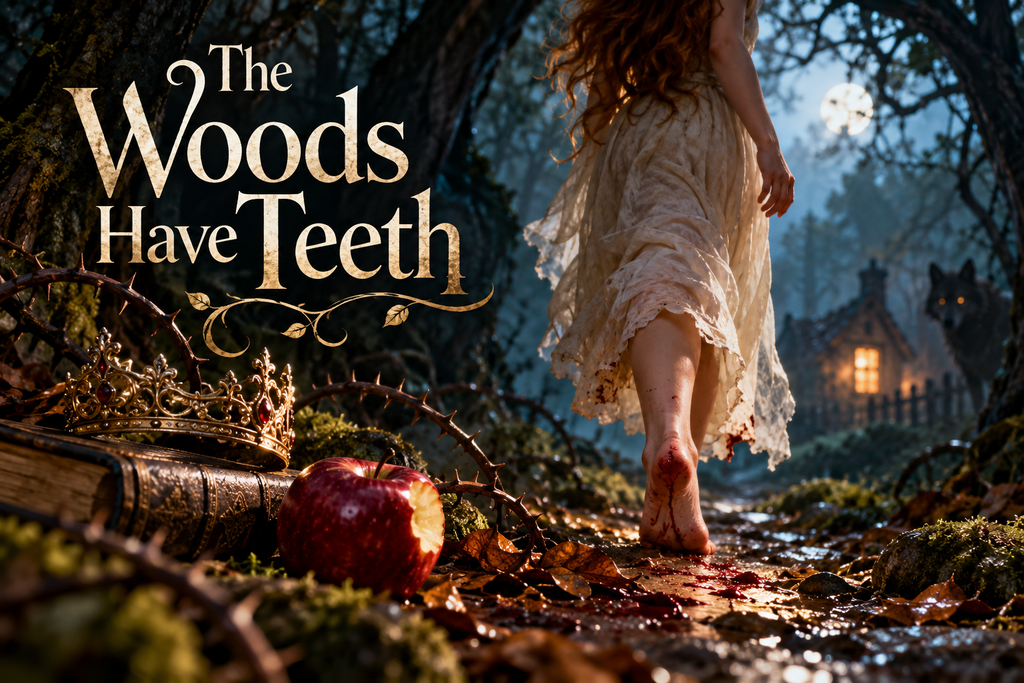
Every step she took felt as though she were walking on knives.
That’s the bit Disney left out.
In Hans Christian Andersen’s The Little Mermaid, becoming human isn’t a sparkly transformation followed by an energetic musical number. The sea witch warns the little mermaid that although she will gain beautiful legs, every step she takes will feel as though she is treading on sharp knives.
She does it anyway.
Fairy tales are gruesome.
Not the versions most of us met as children, perhaps. Those have been polished considerably over the years. But go back far enough and you find mutilation, abandonment, starvation, murder, cannibalism, children being cooked in ovens, people being blinded, and punishments that would make a modern horror writer pause to admire the creativity.
Cinderella’s stepsisters cut pieces off their feet to make the slipper fit. The prince in Rapunzel falls into thorns and is blinded. The wicked queen in Snow White is forced to dance in red-hot iron shoes. And the little mermaid walks on knives.
It is tempting to look at all this and conclude that our ancestors had a very peculiar idea of children’s entertainment. But I wonder if we’re looking at it backwards.
Their world really was dangerous. The woods had teeth.
A child who wandered away from home could genuinely disappear. Hunger wasn’t an abstract misfortune happening somewhere else. Winter could kill you. So could childbirth, an infected scratch, spoiled food, the wrong mushroom, a stranger on the road, or an animal in the forest.
And the old woman really was wise. Not because age automatically confers wisdom, but because becoming an old woman in a dangerous world meant that you had successfully avoided a remarkable number of stupid ways to die.
She knew which berries you could eat. She knew what the clouds meant. She knew which plants might ease a fever and which ones would make things considerably worse. She remembered the last bad winter, the flood, the sickness, the family nobody talked about anymore. She knew who could be trusted.
Most importantly, she had lived long enough to see what happened to people who got things wrong.
Put her at the edge of a forest, give her a crooked cottage and let a few generations retell the story, and perhaps it isn’t surprising that she becomes something more than an old woman.
Fairy tales turn practical dangers into monsters.
- Don’t leave the path.
- Don’t wander alone after dark.
- Don’t trust the charming stranger.
- Don’t go into someone else’s house just because the door is open.
- Don’t eat things when you don’t know what they are.
- Be suspicious when someone offers you exactly what you want.
- Listen to the old woman who tells you not to go into the woods.
These aren’t bad survival rules.
Perhaps that’s one reason the old stories still have such power over fantasy. Most of us no longer need to fear being eaten by wolves on the way to Grandmother’s house. We have streetlights and supermarkets and antibiotics and weather forecasts. The forest has become somewhere we go deliberately, wearing expensive boots and carrying granola bars.
But put a character alone beneath enormous trees, with the path disappearing behind her and something moving where she can’t quite see it…and we know.
Some ancient part of us still understands that forests are dangerous. We still understand the old woman who knows things nobody else does. We still distrust the beautiful stranger bearing gifts.
We still know that bargains have prices, wishes have consequences, and there are some doors sensible people do not open.
Modern fantasy didn’t make the old stories dark. They were dark already.
Perhaps the strange thing isn’t that our ancestors told stories filled with wolves, witches, starvation, abandonment and death. Perhaps the strange thing is that somewhere along the way, we decided to pretend the woods never had teeth.
What’s your favourite fairy tale? The Grimm brothers collected dozens of them, and there are hundreds more from traditions around the world. Have a think about the underlying darkness in that tale. Was it an object lesson? You’ll be surprised by some of the underlying messaging in old wives’ tales and fairy tales, when you get right down to it.

.
.
Newly Released: Street Magic IV — After the Quieting. — Veilbound — Firebird Omnibus