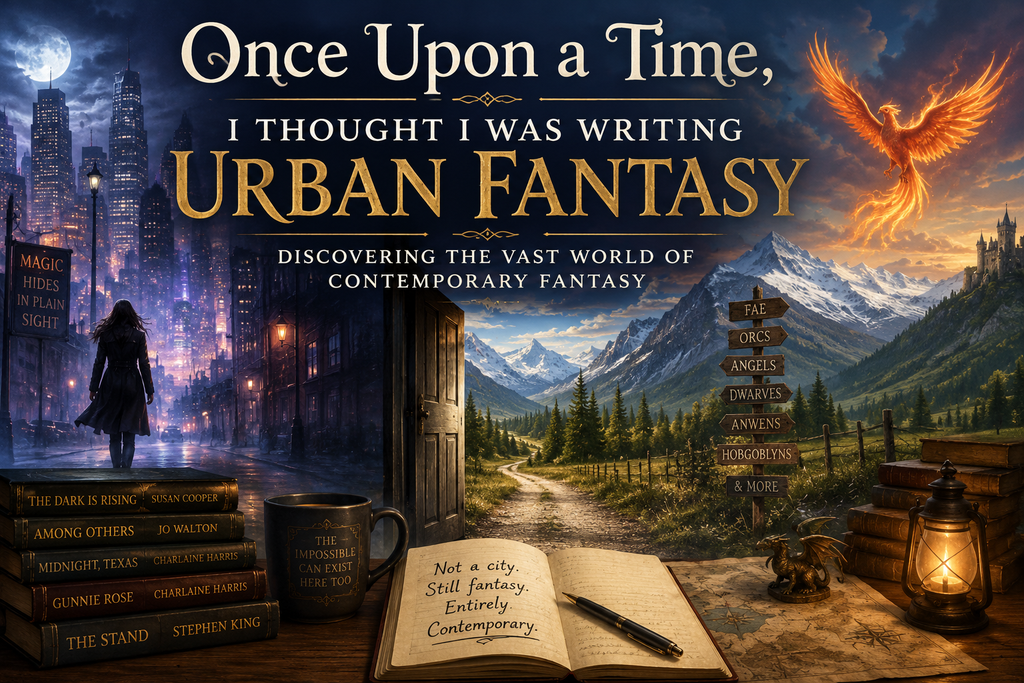
For years, I said I wrote urban fantasy. This seemed perfectly reasonable to me. My stories took place in our world, more or less as we know it, except that our world also contained things that weren’t supposed to exist. Magic. Supernatural creatures. The usual complications. Therefore, Urban fantasy.
Then I wrote stories set in the foothills of the Alberta Rocky Mountains. And readers pointed out a slight problem. “It’s not urban.”
Well. They had me there. There were mountains. Forests. Gravel roads. Small towns. Considerably more wildlife than public transit. Along with fae, orcs, angels, a firebird, dwarves, anwens, hobgoblyns, and more.
Apparently, somewhere along the way, I had decided that “urban fantasy” meant “fantasy set in the contemporary real world,” when, actually, it doesn’t. Or at least, not exactly.
So What Is Urban Fantasy?
This is where we venture into the dangerous wilderness of genre definitions, from which few return without somebody telling them they’re wrong.
The simplest definition of urban fantasy is fantasy set in an urban environment. Magic in the city. Supernatural creatures wandering down streets that appear on Google Maps. Vampires who have to worry about traffic.
That’s the definition I tend to favour these days, largely because it has the advantage of making sense. But urban fantasy also has a narrower meaning based not just on setting, but on feel.
The genre has strong roots in noir and detective fiction. Its worlds tend to have dark edges. There are often mysteries, crimes, supernatural factions and complicated power structures. Vampires, werewolves, witches, fae and other supernatural species may have their own societies, alliances and long-running grudges.
In a lot of urban fantasy, particularly the books that helped define the genre, conflict between supernatural groups is a major part of the story.
Plus, the city itself matters. It’s not just where the characters happen to live. It has a presence and personality of its own. Sometimes it feels almost like another character.
Of course, not every book we call urban fantasy has all of those things. Because that would make genre classification far too easy.
Charlaine Harris’s Sookie Stackhouse books, for example, are usually classified as urban fantasy. They certainly feel like urban fantasy. There are vampires, shapeshifters and other supernatural species. There are factions, politics, mysteries, violence and a supernatural world operating alongside the human one.
But Sookie lives in Bon Temps, Louisiana. Population: not terribly urban.
The True Blood television adaptation leaned even harder into the dark, dangerous urban-fantasy atmosphere, despite much of the story still revolving around a small Louisiana town.
So “urban fantasy” isn’t entirely about cities. Except when it is. You can see why I eventually stopped trying to make the term do all the work I had originally assigned to it.
What I Was Actually Writing
The broader term I’d been looking for was contemporary fantasy. Urban fantasy fits inside contemporary fantasy, but contemporary fantasy is much, much bigger than that.
At its simplest, contemporary fantasy takes the world we recognize and introduces the fantastic. That’s it.
And once you think about what that actually allows a writer to do, the possibilities become enormous.
The fantastic doesn’t have to appear in Chicago or London or New York. It can appear in a small town. On a farm. In the mountains. At a boarding school. In someone’s kitchen. (Ahem. See my story, “Sigils in Snow” in the upcoming Street Magic IV.)
It doesn’t have to involve vampires and werewolves fighting over territory. The magic can be enormous and world-changing, or so quiet that half the characters don’t realize it’s there.
I’ve written stories set in Naples, and involving the Mafia. Turkey, where the fae have virtually enslaved humanity.
I’ve had a couple of ex lovers resolve their differences sitting under a mother tree in the Pacific Northwest.
The story can be funny, romantic, frightening, literary, adventurous, mysterious or downright apocalyptic.
It can borrow from other genres until everyone involved in shelving the book develops a headache.
What holds these stories together isn’t a particular kind of magic or creature. It’s the collision between the fantastic and a recognizable world. And apparently that was what fascinated me all along.
How Big Can Contemporary Fantasy Get?
Susan Cooper’s The Dark Is Rising series is a wonderful example. The books were written beginning in the 1960s and continuing through the 1970s, so their “contemporary” world obviously isn’t ours anymore. But it was contemporary when Cooper wrote it.
The setting is recognizable Britain. Into it Cooper weaves Arthurian legend, ancient powers, magic and the struggle between the Light and the Dark. The everyday world and the mythic world occupy the same space.
Jo Walton’s Among Others goes somewhere quite different. It’s set in Wales and England in the late 1970s and follows a teenage girl dealing with family, boarding school and her passionate love of science fiction and fantasy books. There are also fairies. And magic.
But the magic doesn’t turn the novel into the sort of supernatural adventure we normally associate with urban fantasy. It’s quieter and stranger than that, woven through an intensely recognizable life.
Then there’s Charlaine Harris’s Midnight, Texas series, which plants an assortment of supernatural and decidedly unusual people in a tiny Texas town. Not terribly urban either. Very definitely fantastic.
Harris’s Gunnie Rose series wanders even farther across the genre map. It’s fantasy. It’s alternate history. It’s a western. It has magic, gunslingers, the Russian royal family and a version of North America whose history took a dramatically different turn from ours.
Trying to force it into one neat category rather misses the fun.
And then there’s Stephen King’s The Stand. Yes, I’m going there. Most people would quite reasonably describe The Stand as post-apocalyptic horror.
But it’s also a story set in a recognizable contemporary America in which supernatural forces are very real. Its survivors are drawn together through dreams. Mother Abagail and Randall Flagg represent forces far larger than themselves, and the struggle that develops isn’t merely about surviving a pandemic and rebuilding civilization.
Is The Stand contemporary fantasy? You could certainly argue it. And even if you don’t want to put it on that particular shelf, the fact that the argument can be made shows just how far contemporary fantasy can stretch.
Genre Labels Are Maps, Not Borders
I think this was the mistake I made when I originally called everything I wrote urban fantasy. I’d found one part of fantasy that fascinated me and assumed the label applied to the whole thing. It didn’t.
Urban fantasy is one particular territory within a much larger landscape. And even its borders are fuzzy. Sookie Stackhouse can live in rural Louisiana and still feel unmistakably like urban fantasy. A story can take place in a city and have almost none of the characteristics we’ve come to associate with the genre.
Genre labels are useful. Readers need some idea of what they’re getting into. Publishers and booksellers need some way of describing books. Online stores insist on putting them into categories whether they cooperate or not.
But the stories themselves don’t necessarily care. They wander across boundaries. They borrow things. They combine genres that supposedly don’t belong together.
Which brings me back to the Harley Firebird series that I set in the Alberta foothills. My readers were right. The series isn’t urban fantasy. I didn’t switch genres, though. I’d been writing contemporary fantasy all along, so I just changed the labels.
Some of my stories sit closer to urban fantasy. Others don’t. Roots of the Storm, for example, edges toward magical realism.
What connects them isn’t a city. It’s the idea that the fantastic doesn’t have to exist safely on the other side of a portal, or in a kingdom on a map at the front of the book. It can be here. And having magic happen here — in our towns and forests and houses, on roads we’ve driven and in landscapes we recognize — makes it even stranger in comparison to our mundane world. And far more delicious.
The impossible can exist right beside the ordinary. And once you start with that premise, you can go almost anywhere.
.
.
Newly Released: After the Quieting. — Veilbound — Firebird Omnibus