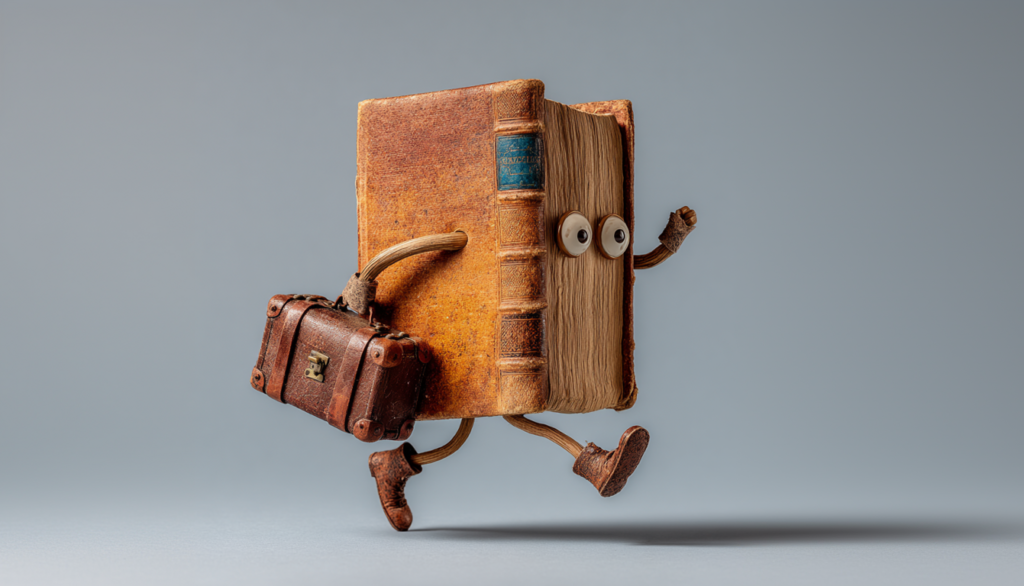
If you’ve ever felt like your ebook collection is more of a rental than an actual library, you’re not wrong. Most retailers make it really easy to buy—one click, done—but they also make it deliberately hard to take your books with you if you ever want to leave. And let’s not sugarcoat this: Amazon is the worst offender.
But it doesn’t have to be that way. It’s entirely possible to build an ebook library that’s yours. Independent, portable, safe, secure, and backed up. A library that lives on your hard drive—not inside someone else’s walled garden.
Let’s talk about becoming platform agnostic.
Your Library, Your Rules
When you buy a physical book, you get to shelve it where you like, pack it in a box and take it with you if you move. The digital equivalent should be the same. That’s what being platform agnostic is about: not being locked into a single device, retailer, or app just because you happened to click “Buy” there once.
It starts with this simple rule: Keep your ebooks somewhere you control. Not locked inside Amazon’s cloud or Kobo’s or Apple’s or anyone else’s. Back them up. Sort them. Store them in a library you can actually manage.
Enter Calibre: The Swiss Army Knife of Ebook Management
I’ve sung Calibre’s praises before on the Tracy Cooper-Posey site [here and here, among others], but it bears repeating. Calibre is, without exaggeration, one of the most powerful tools available to readers who want control over their digital library.
You can:
- Sort and organize thousands of books
- Edit metadata (like titles, blurbs, and those precious series numbers!)
- Find missing covers and fill in the gaps
- Add your own ratings, notes, and tags
- Read books right in the app
- Sync your collection to cloud storage
- Transfer to any device you like
I donate to Calibre every year because I honestly couldn’t manage my reading life without it.
Download it here: https://calibre-ebook.com/download
Want to see it in action? Watch the demo video: https://calibre-ebook.com/demo
Read on Anything
Once your books are in your own library, you’re free to read them however you want. Try out apps like Moon+ Reader or FBReader. Personally, I use Google Play Books—you can upload any EPUB or PDF, and it syncs across devices without fuss. No weird blank covers or disappearing downloads just because the book didn’t come from their store.
Buy From Anywhere
Being agnostic isn’t just about reading—it’s about buying too. If a book is available on Kobo, Smashwords, or direct from the author, grab it there. Amazon exclusivity is real, and yes, it’s frustrating. But the more we support open platforms, the more they’ll grow.
And yes, sometimes you’ll need to take a few extra steps to get a book from point A to your reader of choice. But those few minutes are worth it for the long-term control you get.
And here’s the real magic: once your library is centralized and you know how to manage your books, you’re free to buy directly from any author, anywhere. That opens up a world of benefits—author-direct discounts, exclusive editions, early access, and those lovely multi-book bundles that often never make it to the big stores. Direct sales are often better for authors and readers, and once you’ve gone that route, you may never want to go back.
A Note on DRM
Now, about DRM—Digital Rights Management. Books that are DRM-locked can’t be opened outside the retailer’s own ecosystem. That means you can’t load them into Calibre or read them in your chosen app. There are tools out there that can remove DRM, and many readers use them in order to centralize their personal libraries.
However, be aware that doing so may violate the terms of service of whichever retailer you bought from. It’s a personal decision, and one to make with eyes open.
Take Back Your Library
Amazon recently backed off from their new policy of not allowing downloads of purchased books—a rare reversal. That makes this a very good time to begin reclaiming your Kindle content. The same applies to other retailers, too. If you’ve ever felt like your ebooks were being held hostage, this is your moment to start moving them into your own space.
Here’s a simple approach to building your own independent ebook library:
- Start small. Figure out how to get just one book out of your retailer’s walled garden and into your own reading system.
- Be consistent. Each day or week after that, systematically extract five or ten more books and add them to your library.
- Add as you go. While you’re doing that, get into the habit of adding every new book you buy directly into your centralized library.
Eventually, you’ll have every book you’ve ever purchased safely under your own roof. If you buy from multiple retailers, start with the one that has the smallest number of your books—it’ll give you an easy win—then move on from there in order of collection size.
Freedom doesn’t have to be overwhelming—it just needs to be intentional.
And once you’ve seen what it’s like to actually own your books, you’ll wonder why you ever settled for anything else.
.
.
Available for pre-order: After the Quieting.
Newly Released: Veilbound — Firebird Omnibus — Sylvalight
I’ve been using Calibre for years. I have thousands of books on Kindle format, but haven’t been able to do much about it. Amazon has been very resistant to allowing customers to download what they purchase, instead using the “you purchased a license, not a book” dodge to keep from actually giving you a copy you can read on any device you want. Even the titles from publishers who state up front that their titles are “DRM free” have had their books put in literary jail by Amazon’s policies. There has been a lot of pressure to address this.
In the meantime, I’ve been adding to my Calibre library from other sources that don’t do this. BookFunnel, where I get your books from (even a bundle or super-bundle or two), Humble Bundle collections of novels, graphic novels, comic collections, computer science books, and tutorials on a dozen subjects (make sure you look to make sure they come DRM free — I got snookered into a collection they sourced from Kobo, all larded up with Adobe DRM), sites that have downloadable libraries on various subjects, like the Von Mises Library (mises.org) has for economics and philosophy texts, and books on drawing and other art forms from sites that don’t lock them down.
Not counting my Amazon collection, I have nearly a thousand books in my Calibre library without DRM. I found a tool to jailbreak my audiobook collection as well, so I have all of those on my big 8 TB RAID array I bought from Staples with reward points from my credit card. I can play them on anything, but a player app that keeps track of your current place in the audiobooks you’re listening to is a Good Thing(tm). I’ve been getting public domain books from Project Gutenberg and their audiobook counterparts from Librivox for many years now, especially the nearly entire collection of H. Beam Piper stories — a must for SF readers. We lost Piper tragically just as his career was taking off, and I was very glad to see that his stories were not lost. But there’s also the works of tons of other authors, in every genre. Want everything Lewis Carroll wrote, or the entire L. Frank Baum OZ collection? They’re available under public domain. Calibre is amazing at keeping track of such collections.
Another thing that Calibre has is a personal website feature. You can make yourself an account on your own computer, with a password to keep unwelcome visitors out of your books, and access it with devices you own with Wi-Fi capability. Just browse your collection on the webpage Calibre maintains for you, and save the one you want to your ebooks reader’s folder.
In closing, anyone who loves the books they purchase should write to the publishers of your favorites that sell them DRM free, and request that they please go through Author-X’s books and make sure the DRM free download option is selected, so you can keep your beloved titles where they can’t be deleted or worse, altered, without your permission. (Amazon has been modifying titles, mostly from authors who have passed away, and whose estates don’t monitor such things. Most of the modifications have been to make scenes, words, or phrases conform to “current audience” feelings. Imagine opening Huckleberry Finn to find that a character’s NAME has been bowdlerized. It happened.)
Tools like Calibre make it possible to maintain your personal digital libraries, convert formats of ebooks where necessary, and transfer them painlessly to your e-readers and other devices. I’m very glad to see Tracy and her many faces advocating for reader independence, something I’m very passionate about!
https://www.publishersweekly.com/pw/newsbrief/index.html?record=5675
Phew, Gwen! You’re a good few steps ahead of most readers!
I do want to reiterate that “jail breaking” is technically against the terms of nearly all user agreements for all retailers, and that punitive fines can be levied if the retailer chooses to pursue the matter.
Jailbreaking is a personal choice each reader must make.
Which is why I encourage all readers to go direct to the author wherever an author sells direct; then the silly business of DRM and exclusivity chokepoints doesn’t exist.
Taylen.