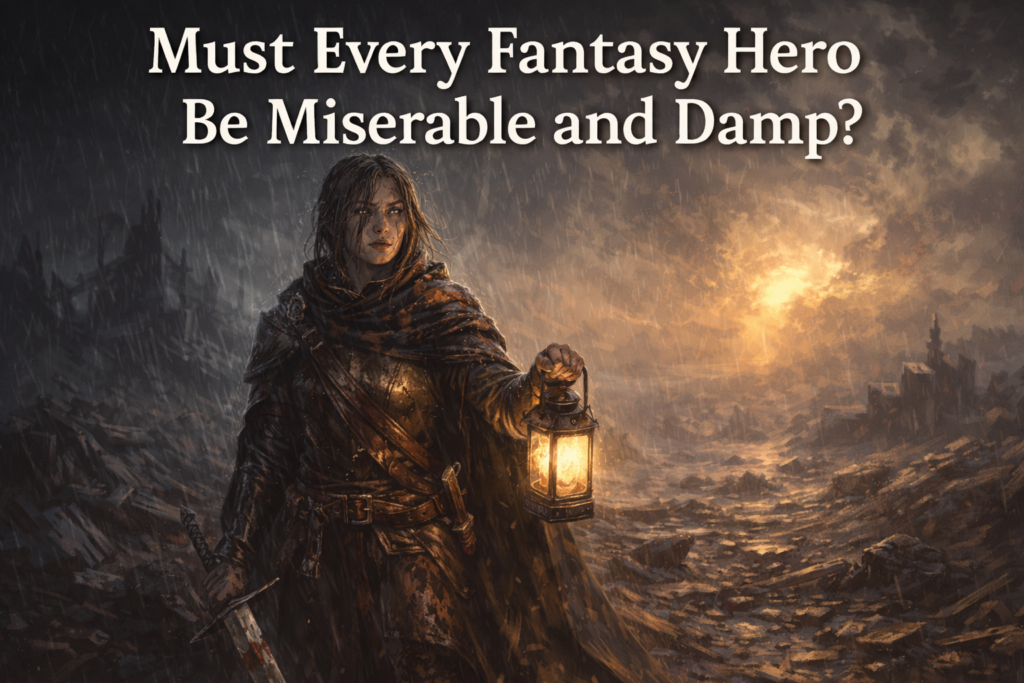
Somewhere along the way, fantasy began to confuse “grimdark” with “serious.”
A story can be sad without being grimdark. It can be painful, difficult, even heart-wrenching, without being hopeless.
Grimdark says there is no point in trying.
An optimistic story says there is.
That distinction matters, because lately I have noticed a curious assumption among readers that if a story contains grief, sacrifice, danger, loss, or a world in trouble, then it must therefore be pessimistic.
No.
A pessimistic story says that nothing can be saved.
A hopeful story says that perhaps it can.
The difference is not whether bad things happen. The difference is whether the characters choose to fight anyway.
Fantasy has spent the last couple of decades becoming steadily darker.
Entire kingdoms are corrupt. The heroes are morally compromised. The villains are often more charming than the heroes. Everybody is traumatised, morally dubious, and apparently living under a cloud that rains continuously.
Nobody in fantasy has discovered towels.
Why read grimdark?
Now, before anyone hurls a muddy sword at me, I understand the appeal of grimdark.
It rejects stories where morality is simple and everyone is easily labelled hero or villain. It offers flawed characters, difficult choices, and consequences that hurt. It can feel honest in a world that is often messy, unfair and frightening.
And it can be oddly cathartic. When the real world feels bleak, there is a certain satisfaction in reading about a fictional world that is even worse.
Fair enough.
But somewhere along the way, fantasy also began to assume that grimdark was the only mature way to tell a story. As if hope were childish. As if decency were unrealistic. As if the only believable ending involved betrayal, death, rain, and perhaps a protagonist staring moodily into the middle distance while regretting everything.
I disagree.
I do not write spotless heroes in white hats who always know exactly what to do. My characters make mistakes. They panic. They get angry. They trust the wrong people, or fail to trust the right ones. Sometimes they do foolish things with all the good judgement of an intoxicated goat.
Nor do I write villains who are evil merely because the script requires someone to twirl a moustache and cackle.
My characters are complicated.
Complicated is not the same thing as hopeless.
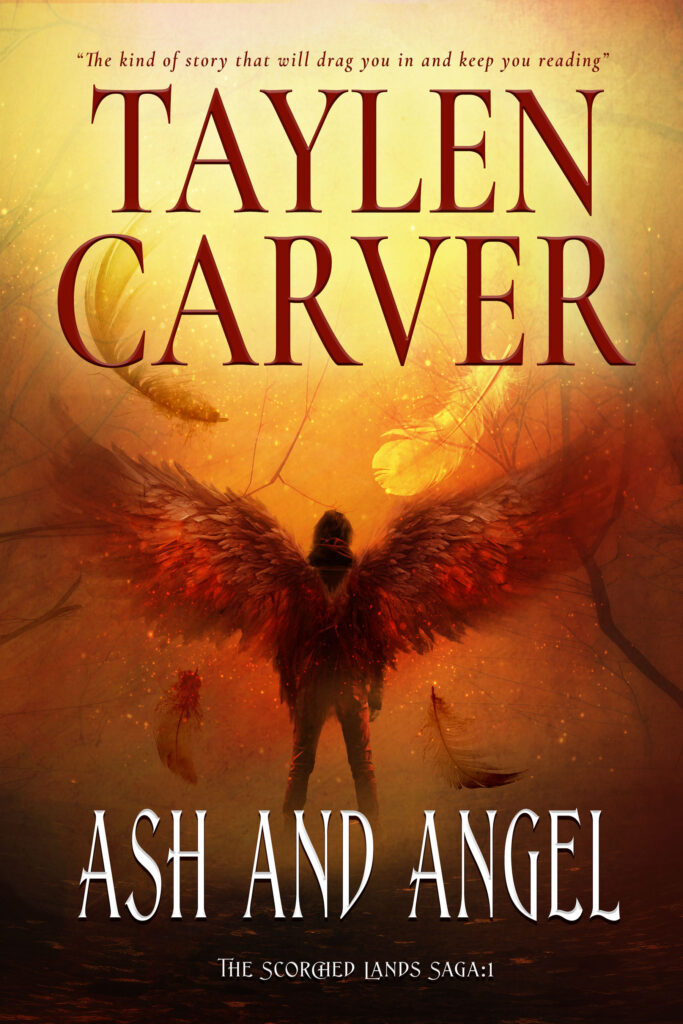
Take Ash and Angel. That world is not a cheerful place. It is damaged, dangerous, and full of people making terrible decisions for understandable reasons. The characters suffer. They lose things. They endure grief, fear and betrayal.
By some definitions, that apparently makes the story “dark.”
Perhaps.
But it is not grimdark.
Because the characters keep trying.
They still believe that people matter. They still fight for each other. They still make choices based on loyalty, love, courage, duty, or sheer bloody-minded refusal to surrender.
That is not pessimism.
That is hope under pressure.
And, frankly, I think that is much closer to real life than either fairy-tale simplicity or grimdark nihilism.
Real people are not spotless heroes.
We make mistakes. We fail. We get frightened. We do stupid things.
But we are also capable of astonishing courage.
We keep going when the odds are terrible. We help each other. We make sacrifices. We choose kindness when cruelty would be easier. We try again after failure.
If grimdark were truly realistic, the human race would have died out centuries ago because nobody would ever help anyone.
The stories I write are not about people giving up.
They are about people who have every reason to give up—and decide not to.
Sometimes they save the world. Sometimes they save one person. Sometimes they fail, and have to keep going anyway.
That does not make the story less serious.
It makes it more so.
I do not believe that goodness is easy.
I believe it is difficult. I believe courage is difficult. Loyalty is difficult. Hope is difficult.
Which is exactly why they matter.
Fantasy does not need to be grimdark to feel real.
It only needs characters who have every reason to surrender—and choose not to.
What about you?
Do you enjoy grimdark fantasy—stories where the world is broken and the characters are, too? If so, what draws you to it?
Or do you prefer fantasy that may be dark, painful and difficult, but still leaves you with a sense that people, and perhaps even the world, can be saved?
Tell me in the comments. I am genuinely curious.
And if you are one of the people who enjoys stories full of battered, frightened, stubborn characters who refuse to give up, well…you may be in the right place.
.
.
Coming soon: After the Quieting.
Newly Released: Veilbound — Firebird Omnibus — Sylvalight