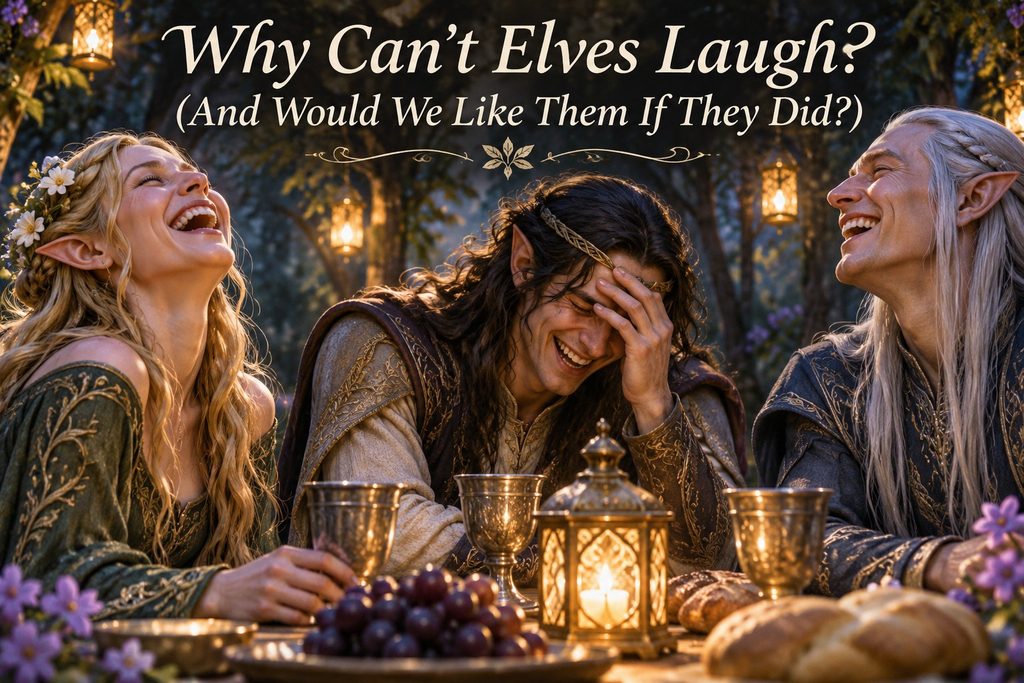
Today is Loosen Up, Lighten Up Day, which has me thinking about fantasy characters who could desperately use a little less solemnity in their lives.
Elves, for example.
When was the last time you saw an elf laugh at something genuinely ridiculous? Not a delicate, musical chuckle at some charming mortal foolishness, but an honest-to-goodness belly laugh? The sort that leaves you gasping for breath and wiping your eyes?
Or a wizard, for that matter?
Gandalf has a sense of humour, certainly. He’s particularly amused by hobbits, and occasionally downright mischievous. But he rarely loses his dignity. Aragorn can be knocked flat on his back, but Gandalf stands there, staff in hand, peering thoughtfully at the incoming birds.
Even my own wizard, Magorian, is a grim and serious fellow. Although in his defence, he’s got a thoroughly unpleasant history, he’s a recovering alcoholic, and he’s currently trying to save the world from gods while the world steadfastly refuses to cooperate.
High stakes, high stress, and not much opportunity to relax. Magorian has excellent reasons for being permanently clenched.
But what about the elves?
Tolkien’s Elves Weren’t Always So Serious
Here’s something interesting. Tolkien’s elves weren’t nearly as solemn as their movie counterparts.
In The Fellowship of the Ring, Frodo and Sam encounter a company of elves while they’re still in the Shire. The elves are cheerful, teasing, and hospitable. They invite the hobbits to share their evening meal, followed by music and singing.
These are people who enjoy themselves.
In Peter Jackson’s film, that encounter becomes something entirely different. The elves pass through the woods, beautiful and distant, singing as they make their way toward the Grey Havens. Frodo explains that they’re leaving Middle-earth, and Sam finds the whole thing terribly sad.
Which it is, of course. But we’ve lost something in the translation.
The elves have become symbols of melancholy and fading beauty, rather than individuals who might be just as likely to enjoy a good joke as contemplate the passing of an age.
And somewhere along the way, this version of elves became the one we expect. Solemn. Wise. Otherworldly. Occasionally a little condescending. Not the sort of people you’d invite to a party unless you wanted everyone to sit quietly and discuss the decline of civilization.
The Problem With Entire Races Having One Personality
Science fiction has the same problem. Vulcans are logical. Klingons are warlike. Ferengi are greedy.
Fantasy has its own collection of assumptions. Dwarves are stubborn, practical, and fond of mining. Elves are elegant and wise. Orcs are violent. Wizards are mysterious and serious.
It’s a convenient shortcut. We can introduce an elf, and readers immediately have a pretty good idea of what sort of character they’ve encountered. Except that isn’t how people work.
Imagine an entire human population in which everyone had exactly the same temperament, sense of humour, priorities, and approach to life. Impossible, right? Yet we accept it without question when the people in question have pointed ears.
There’s even a term for this in speculative fiction: the planet of hats. An entire species or civilization is defined by one dominant characteristic, and almost everyone behaves accordingly. The trouble is that once those expectations become established, breaking them can be surprisingly uncomfortable. I know, because it happened to me.
The Vulcan Who Made Me Uncomfortable
The first time I watched Star Trek V: The Final Frontier, I was genuinely unsettled by Sybok. Here was a Vulcan who laughed. Who was openly emotional. Who lied, manipulated, and behaved in ways that seemed utterly incompatible with everything I understood about Vulcans. He was also Spock’s half-brother, which somehow made it worse.
I remember feeling distinctly uncomfortable whenever he was on screen. Not because the character was inherently unbelievable. In fact, the notion of a Vulcan who rejects the rigid emotional discipline of his culture is perfectly reasonable. But he was a Vulcan. Vulcans don’t do that.
Except, apparently, some of them do. That should have made him more interesting. Instead, I found his behaviour disturbing. I’ve never watched that movie again.
Now, I’m not claiming Sybok is the sole reason. Star Trek V has plenty of other problems. But my reaction to him has stayed with me, because it revealed something about my own expectations. I wanted Vulcans to behave like Vulcans. Even though I knew perfectly well that they couldn’t all be the same.
Do We Actually Want Our Fantasy Characters to Lighten Up?
Which brings me back to Loosen Up, Lighten Up Day. It’s easy to suggest that our favourite fantasy characters should relax a little. That Gandalf should occasionally make a fool of himself. That an elf should laugh so hard he falls off his chair. That a dwarf might prefer flower arranging to swinging a battleaxe. But would we actually enjoy seeing those things?
Or would we feel that something fundamental about the fictional world had been violated?
There are good reasons why writers lean on familiar characteristics. They help establish a world quickly. They give readers recognizable patterns to navigate. And in a story filled with magic, strange creatures, unfamiliar geography, and complicated histories, a little predictability can be comforting.
But there’s a difference between establishing a culture and insisting that everyone within it has the same personality. A culture that values restraint can still produce exuberant individuals. A warrior society can have pacifists. A race renowned for wisdom can produce fools.
And surely a thousand-year-old elf, having witnessed centuries of human beings making the same ridiculous mistakes, might eventually develop an absolutely wicked sense of humour? You’d think that the longer you lived, the more absurd life would become.
Perhaps the greatest sign of wisdom isn’t solemnity at all. Perhaps it’s the ability to laugh at yourself.
Maybe We’re the Ones Who Need to Lighten Up
I don’t expect Magorian to start cracking jokes any time soon. He’s got rather more pressing concerns, and his inability to relax is very much part of who he is. But I do wonder whether I’ve been too quick to accept the solemn wizard, the dignified elf, and the stubborn dwarf as natural laws of fantasy.
And I wonder how much of that comes from the stories themselves, and how much comes from what we, as readers and viewers, have been trained to expect.
Tolkien’s elves could laugh, sing, tease, and enjoy an evening with friends. Somehow, many of us have come to remember them chiefly as melancholy immortals gazing sadly into the distance.
Maybe it’s time to let them have a little fun again. And maybe we should be prepared to enjoy it when they do. After all, if we can accept dragons, magic, and gods meddling in mortal affairs, surely we can cope with an elf who tells a terrible joke.
Or a Vulcan who laughs.
Although I admit, I’m still working on that last one.
What about you? Is there a fantasy or science fiction character whose unexpected behaviour made you uncomfortable? Or one you’d dearly love to see loosen up for a change?
.
.
Newly Released: Street Magic IV — After the Quieting. — Veilbound — Firebird Omnibus