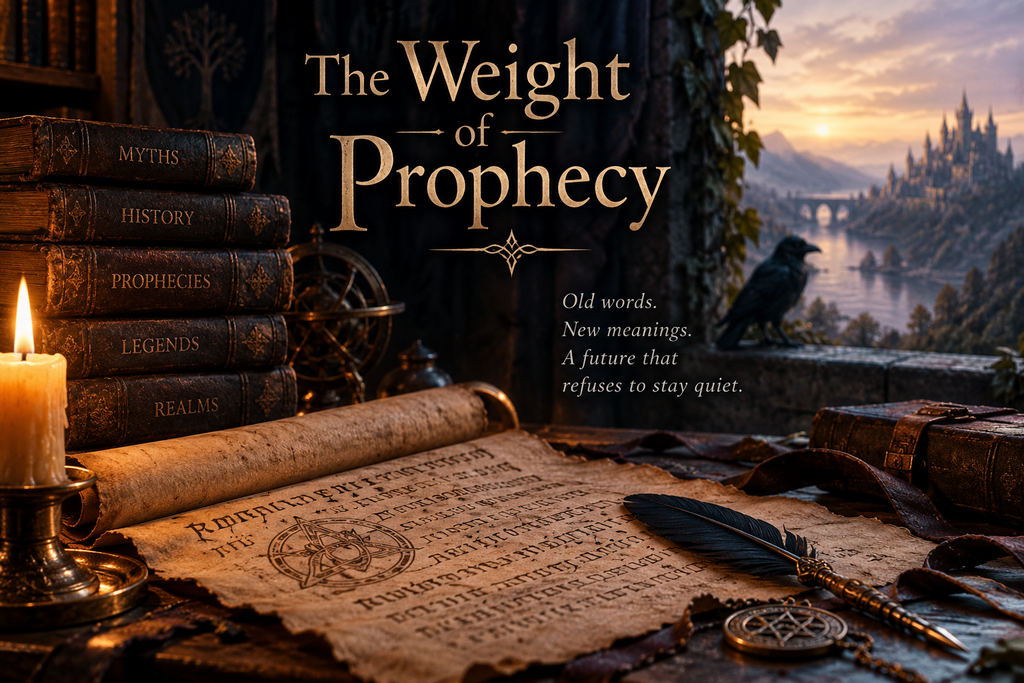
I like me a good prophecy.
Which is odd, because when I stop and think about it, I can’t immediately name a really good prophecy from a fantasy novel I’ve loved. I’m sure they’re out there. Prophecy is one of the oldest tools in the fantasy writer’s box.
The Greeks loved prophecies. The Norse loved them. I’ve used them myself. Under my real name, I wrote an entire 250,000-word fantasy romance, The Branded Rose Prophecy, wrapped around one.
I even have an epic fantasy sitting on the shelf right now, waiting for me to get back to it one day, which features a prophecy.
So clearly, I’m susceptible.
But there’s one version of the fantasy prophecy that has always bothered me.
The old woman appears. Possibly she’s blind. Almost certainly she’s mysterious. She grabs someone’s arm, stares into the middle distance and announces that when the three moons bleed, the forgotten heir will rise and the kingdom will fall.
And everyone believes her.
Why?
Seriously. What can one very old woman know about the future?
We have futurists who spend decades studying trends, economics, politics, technology and human behaviour, and even they get the future woefully wrong. Yet apparently this woman can wander in from the forest, deliver six cryptic lines about something that will happen twenty years from now, and everyone immediately starts rearranging their lives around it.
I’m being unfair, of course. There are fantasy worlds where prophecy and divination are established facts. If everyone knows that the Oracle of Wherever has been reliably predicting volcanic eruptions and royal deaths for the last four hundred years, then yes, you’d probably pay attention when she clears her throat.
But for me, the prophecies that really work have something else behind them.
History.
I love a prophecy that is already old when the story begins.
It was carved into the wall of a temple six hundred years ago. Or written in a book nobody reads anymore. It’s been copied and recopied. Scholars have argued over the translation. Perhaps children know one line of it as a nursery rhyme without knowing where it came from.
Maybe nobody takes it seriously anymore. It’s history. Folklore. An interesting relic from a more superstitious age. Until something happens.
Something that matches the first line. And suddenly everyone is paying attention.
There’s weight behind a prophecy like that. Nobody has to take the original prophet’s supernatural abilities on faith. The prophecy itself demonstrably existed before the events it appears to predict. Generations have known about it. People took enough care to preserve it, even if nobody remembers why.
And now something impossible has happened.
Even better, everyone can disagree about what it means.
One person insists it’s coincidence. Another has believed in the prophecy all her life. A scholar points out that everyone has been mistranslating one crucial word for three hundred years. A ruler discovers that one interpretation threatens his claim to the throne and becomes extremely interested in promoting another.
Perhaps parts of the prophecy have been lost. Perhaps someone deliberately suppressed them. Perhaps there are two surviving versions and nobody knows which is the original.
Now we’re having fun.
Because the prophecy is no longer just a convenient way for the author to tell the protagonist what’s going to happen. It’s now part of the world.
People have grown up with it. Institutions have opinions about it. Religions have interpreted it. Kings may have used it to justify their rule. Scholars have built careers upon arguing about it. Entire generations may have dismissed it as nonsense.
The prophecy has a history of its own.
And then there’s my favourite wrinkle of all: what people do because they believe the prophecy.
The Greeks were particularly good at this.
Again and again, someone learns what fate has in store and takes drastic action to prevent it—only to discover that those actions are precisely what bring the prophecy about.
That’s delicious.
Because now you don’t even have to answer the question of whether prophecy is real.
If a king is told that a particular child will overthrow him, what does he do? What does the child’s family do? What do the king’s enemies do? What happens if thousands of people believe the prophecy?
At that point, the prediction itself has become a force in history. People make decisions because of it. Those decisions have consequences. And those consequences may eventually create exactly the future everyone was trying to prevent.
Which leaves me thinking that perhaps the most interesting question about a prophecy isn’t: Can someone really see the future? It’s: What have generations of people done because they believed someone could?
Give me that prophecy.
Give me the battered manuscript nobody has opened in eighty years. The inscription everyone walks past without seeing. The children’s rhyme whose original meaning has been forgotten.
Then let the first line come true.
I’ll keep reading.
.
.
Newly Released: Street Magic IV — After the Quieting. — Veilbound — Firebird Omnibus