I came across some old notes in my notebooks this morning, and realize that I don’t think I’ve spoken about this before.
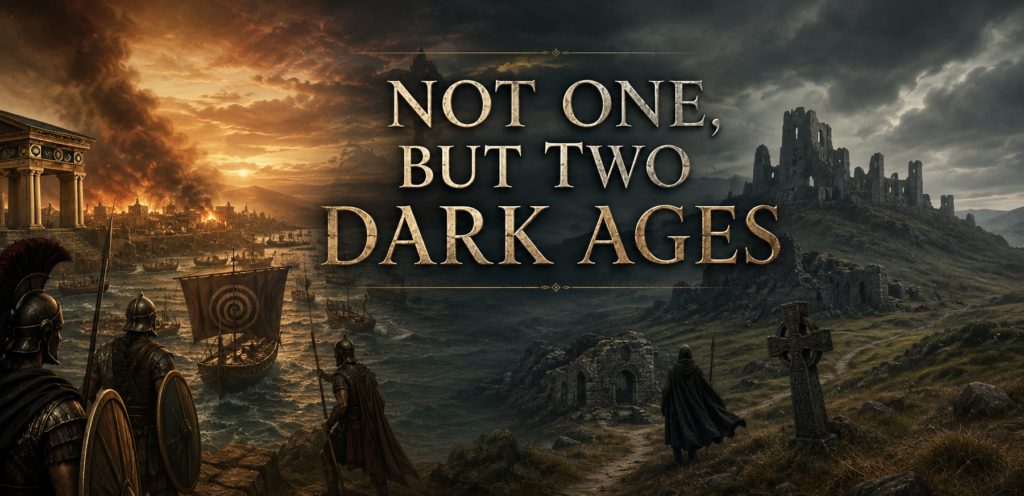
Most people have heard of the Dark Ages. You know the one: Rome falls, Britain fragments, King Arthur may or may not have existed, and historians spend the next few centuries peering into a murky historical fog.
That period was a huge influence on the background of the Magorian & Jones series. A world where empires have fallen, old knowledge has been lost, and myths have quietly replaced history has always fascinated me.
Then, halfway through writing the series, I discovered something I really should have known already. There had been another Dark Age. An earlier one. And, in many ways, an even bigger one.
Around 1200 BC, much of the eastern Mediterranean world simply…collapsed. The great palace civilizations of the Bronze Age disappeared or were transformed beyond recognition. The Hittite Empire vanished entirely. Mycenaean Greece fell apart. International trade networks that had linked kingdoms for centuries broke down. Some regions even lost writing for generations.
It’s one of the great turning points in human history. And we still don’t know exactly why it happened.
Which brings us to one of history’s most wonderfully frustrating mysteries: the Sea Peoples.
They appear in Egyptian records as fierce invaders arriving by both land and sea. They fought Pharaohs. They may have helped bring down kingdoms that had stood for hundreds of years.
And yet, who were they? Where did they come from? Were they invaders? Refugees? Mercenaries? Pirates? A loose alliance of displaced peoples fleeing disasters elsewhere?
Three thousand years later, historians are still arguing.
If I’d written that into a fantasy novel, I suspect at least one reader would have rolled their eyes. “So the mysterious warriors arrive from nowhere, change the fate of half the known world, and then disappear into history? That’s a bit convenient.”
Except history occasionally behaves like an overenthusiastic fantasy author.
The moment I discovered the Bronze Age Collapse, I knew it had to find its way into the Magorian & Jones books.
The later novels in the series revolve around uncovering the truth about an ancient catastrophe that shaped everything that followed. The key to that mystery lies in the ruins of a Minoan palace—a direct result of my becoming hopelessly fascinated by the Bronze Age world and asking myself one irresistible question.
What if something like this had happened in my own world?
One of the things I love most about fantasy is that it lets us explore the blank spaces history leaves behind. What stories survive when civilizations collapse? How much truth remains after a thousand years of legends?
When everyone remembers something happened, but nobody remembers exactly what, what fills the gap?
Sometimes dragons. Sometimes wizards. Sometimes a palace waiting to reveal its secrets.
The funny thing is that people often think fantasy writers invent impossibly dramatic histories. In reality, we usually steal from history. We just tidy it up a bit.
The Bronze Age Collapse remains one of those periods that feels almost impossible. Entire civilizations vanish. Great cities burn. Trade disappears. Kingdoms are erased. Mysterious peoples appear in the historical record just long enough to change the course of history before fading back into uncertainty.
It’s stranger than anything I could have invented.
And if you’ve read the later Magorian & Jones books, now you know where some of those ideas came from.

.
.
Newly Released: Street Magic IV — After the Quieting. — Veilbound — Firebird Omnibus